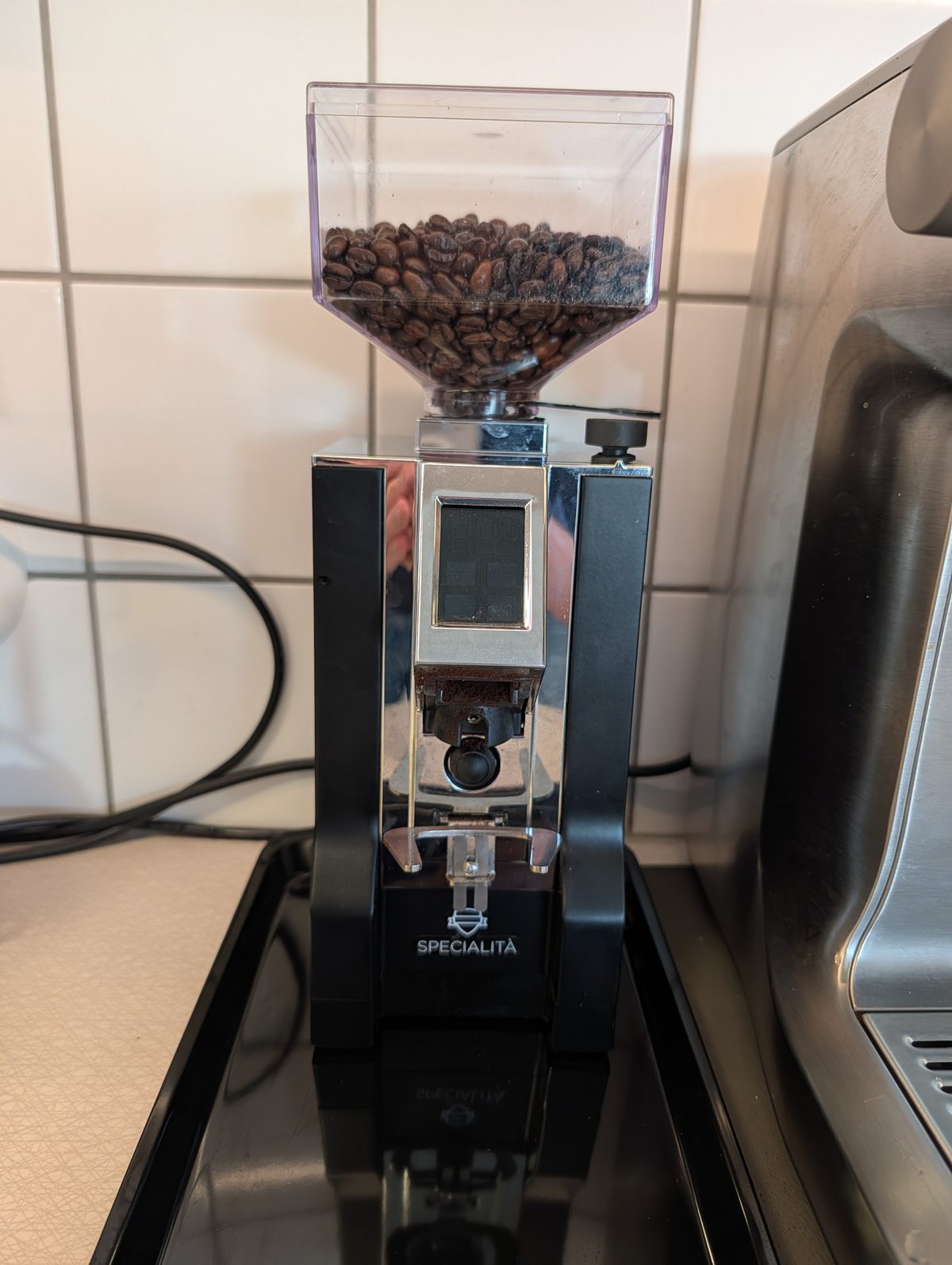
Eureka Mignon Specialità — The Grinder Research Consistently Pointed To
Published 10 May 2026 · Updated May 2026
The grinder that research reliably identifies as the workhorse of the serious home espresso category. Four months in and it just grinds — stepless, quiet, consistent. Built in Florence with 55mm flat burrs and a lifespan counted in decades.
Link updates to your region automatically
When I started researching espresso grinders seriously — while still on the De’Longhi Dedica, before upgrading to the Sage Dual Boiler — the research kept coming back to the same names in the 3,000–5,000 SEK range. The Eureka Mignon Specialità was on every shortlist. Not as a hidden gem or an underrated alternative, but as the established reliable answer: the grinder that the serious home espresso community consistently identifies as the workhorse product of the category.
I bought it in January 2026, a few months after the Sage. 4,309 SEK (€392). Four months in, it grinds through every session without fuss or drama. That is exactly what I wanted from the research.
What I was looking for
The previous grinder was a Graef CM900 — a decent enough entry-level choice that served the Dedica adequately. When I moved to the Sage Dual Boiler, the mismatch became immediately apparent. The Sage’s precision — PID temperature control, adjustable pre-infusion, pressure gauge feedback — was running against a grinder that produced inconsistent particle sizes and required more adjustment than the machine’s accuracy justified. The grinder was the ceiling.
What I needed: stepless grind adjustment, flat burrs at the 55mm range or above, and a motor and construction rated for long-term reliability. Stepless adjustment means I can find the exact grind setting for a specific bean and recipe rather than choosing between two stepped notches that straddle the right answer. Flat burrs at 55mm or above produce the particle distribution that extracts espresso evenly. A robust motor means it will be doing the same job in fifteen years.
The research pointed to the Specialità. I verified the recommendation across multiple independent sources — the espresso communities where people post shot data, extraction curves, and multi-year ownership reports — and found no meaningful dissent. It is considered a trustable 20-year product for home use. I bought it.
What makes the Specialità the research answer
Eureka has been making grinders in Florence since 1920. The Mignon range is their home espresso line, but the engineering does not reflect a compromise of a commercial product — it is purpose-built for home use at a quality level that far exceeds the price point.
The 55mm flat burrs are the core specification. Flat burrs produce a particle distribution suited to espresso: the geometry creates more uniform sizing at fine grind settings than conical alternatives at the same price tier. The extraction clarity from a flat burr at a well-dialled setting is what drives the long-term recommendation from the espresso community.
The stepless adjustment is the control that makes dialling in learnable. A stepped grinder forces you to choose between two adjacent settings; the correct grind for a given bean and recipe often lives between them. Stepless means you can find the right point and return to it precisely. Once I have established the setting for the current bag of beans, I do not adjust it between sessions — the grinder holds the setting reliably, and the shot is consistent.
The ACE system — Eureka’s sound and distribution mechanism — is genuinely effective. Coming from the Graef, the noise difference is significant. The Specialità is not silent, but it is quiet enough that grinding early in the morning is not a household event. This is the kind of daily-life detail that matters over fifteen years of regular use.
The motor is oversized for home demand. Eureka rates it for commercial volumes; at one or two espresso double shots per day, the motor is idling relative to its design capacity. This is the foundation of the 20-year longevity expectation.
Ownership record
Bought January 2026. 4,309 SEK (€392).
Four months in at time of writing. The burr break-in period — the first five to ten kilograms of coffee, during which the machined burr faces wear smooth — is roughly complete. The shots from this point forward reflect the grinder’s actual performance rather than the break-in characteristics.
Build quality
The Specialità is a solid object. Machined aluminium housing over a steel chassis — it does not move on the counter during grinding, does not rattle, and the stepless adjustment collar operates with a deliberate, precise resistance that communicates exactly where you are between settings.
The build finish is consistent and professional. The hopper seats securely. The grounds chute is clean. The display and timer electronics are functional without being fragile — they do the job required of them, and the grinder’s performance does not depend on them in the way it would if they were the primary control system. The mechanical components are the durable core.
How it performs
Four months in, the routine is established: set the timer, grind into portafilter, pull the shot. The Specialità produces the same grind every time at the same setting — once I have dialled in for a particular bean, I trust the timed dose and do not weigh every pull. If I want to be precise, or I am dialling in a new bean, I weigh. But the timed dose is reliable enough for daily use without that step.
Switching beans means dialling in again — the stepless collar needs a few test shots to find the right point for a different roast or origin. It is part of the workflow rather than a problem; I do not find it a significant bother.
On lighter roast single-origin beans, the flat burr character shows in the cup: extraction clarity, defined fruit notes, a shot that has layers rather than a homogeneous profile. The Sage’s temperature precision and the Specialità’s grind consistency work together in the way a matched system should.
The quiet operation has also been a quality-of-life improvement. Grinding three to four times per day, every day, is different at a noise level that does not require thought versus one that wakes people.
True cost of ownership
4,309 SEK (€392) at purchase. At a fifteen-year ownership horizon with replaceable burrs available from Eureka when needed (typically well beyond this point for home use volumes), the annual cost is 287 SEK (€26).
The realistic alternative: a mid-range grinder at 2,500 SEK (€228) — something like a Baratza Encore — replaced three times over fifteen years is 7,500 SEK (€682) total. More expensive, and at a grind quality level that limits what a capable espresso machine can achieve. The Specialità at 4,309 SEK (€392) costs less over the same period and produces better results throughout.
Verdict
Research pointed here consistently, and the research was right. The Eureka Mignon Specialità does exactly what the community says it does: grinds through every session with precision, without complaint, and without requiring management. Quiet enough to use without thinking about it, consistent enough to make the espresso reproducible, and built to last the decade without a question.
At 287 SEK (€26) per year over fifteen years, this is the right answer to the espresso grinder question.
True Cost of Ownership
| Metric | Value |
|---|---|
| Price paid | 4,309 SEK |
| Estimated lifespan | 15 years |
| Cost per year | 287 SEK |
| Budget alternative over same period | 7,500 SEK |
| Net saving vs. budget alternative | 3,191 SEK |
Ownership record
Purchased January 2026 · Reviewed after 4 months of ownership
Good fit for
- ✓Serious home espresso paired with a machine at Sage Dual Boiler level or above
- ✓Those who want stepless grind adjustment for precise dialling
- ✓Anyone who wants a grinder that will last 15-20 years without a second thought
- ✓Single-origin espresso where the extraction window is narrow
Not ideal for
- ✕Filter coffee — this is purpose-built for espresso grind ranges
- ✕Beginners looking for plug-and-play results without learning to dial in
- ✕Those wanting the absolute smallest counter footprint
Pros
- +55mm flat burrs: even particle distribution across the espresso grind range
- +Stepless adjustment — precise, repeatable, no stepped compromises
- +Built and assembled in Florence — genuine Italian manufacturing
- +Quieter than most flat burr grinders at this price — noticeably so versus budget alternatives
- +Designed for the home espresso use volume — motor is oversized relative to demand
Cons
- −Switching beans requires dialling in again — not a big deal, but it is part of the workflow
- −Burrs need a 5–10kg break-in period before reaching peak performance
Frequently Asked Questions
Is the Eureka Mignon Specialità worth the price for home espresso?
At 4,309–5,200 SEK (€370–450), yes — with the right context. The Specialità is not an entry-level purchase; it belongs in a setup where the espresso machine is capable of using what the grinder delivers. Paired with a machine at the Sage Dual Boiler level or equivalent, the stepless adjustment and flat burr precision make consistency achievable in a way that cheaper grinders cannot match. Bought as a 15-year investment, the cost per year is 287–347 SEK (€26–32) — less than a month of café coffees.
Why is the Eureka Mignon Specialità considered a 20-year workhorse?
The motor is sized for commercial use volumes — far beyond what any home user will demand. The burrs are replaceable and available directly from Eureka and specialist retailers. The housing is machined aluminium over a steel chassis: it does not flex, rattle, or degrade from vibration. There are no known structural failure points in long-term home use. Flat burrs wear gradually rather than failing suddenly — owners report years of use before the performance peak begins to shift. For home use, this is a once-in-a-generation purchase.
Is the Eureka Mignon Specialità quiet?
For a flat burr grinder, yes — noticeably so. The ACE (Anti Clump Evolution) sound-dampening system in the Specialità reduces operational noise compared to unhoused grinders. It is not silent, but in a kitchen setting it is not intrusive. After coming from a Graef CM900 — which was significantly louder — the difference in daily use is clear.
Do you need to weigh every dose with the Eureka Mignon Specialità?
Not necessarily. Once you have dialled in a setting for a given bean, the timed dose is reliable enough to use as-is — the grinder produces a consistent output at the same setting every time. I use the timer for daily shots and trust it. If I want more precision — when dialling in a new bean or chasing a specific recipe — I will weigh, but it is not a requirement for every pull. The workflow is flexible: use the timer when you trust the setting, weigh when you want to be exact.