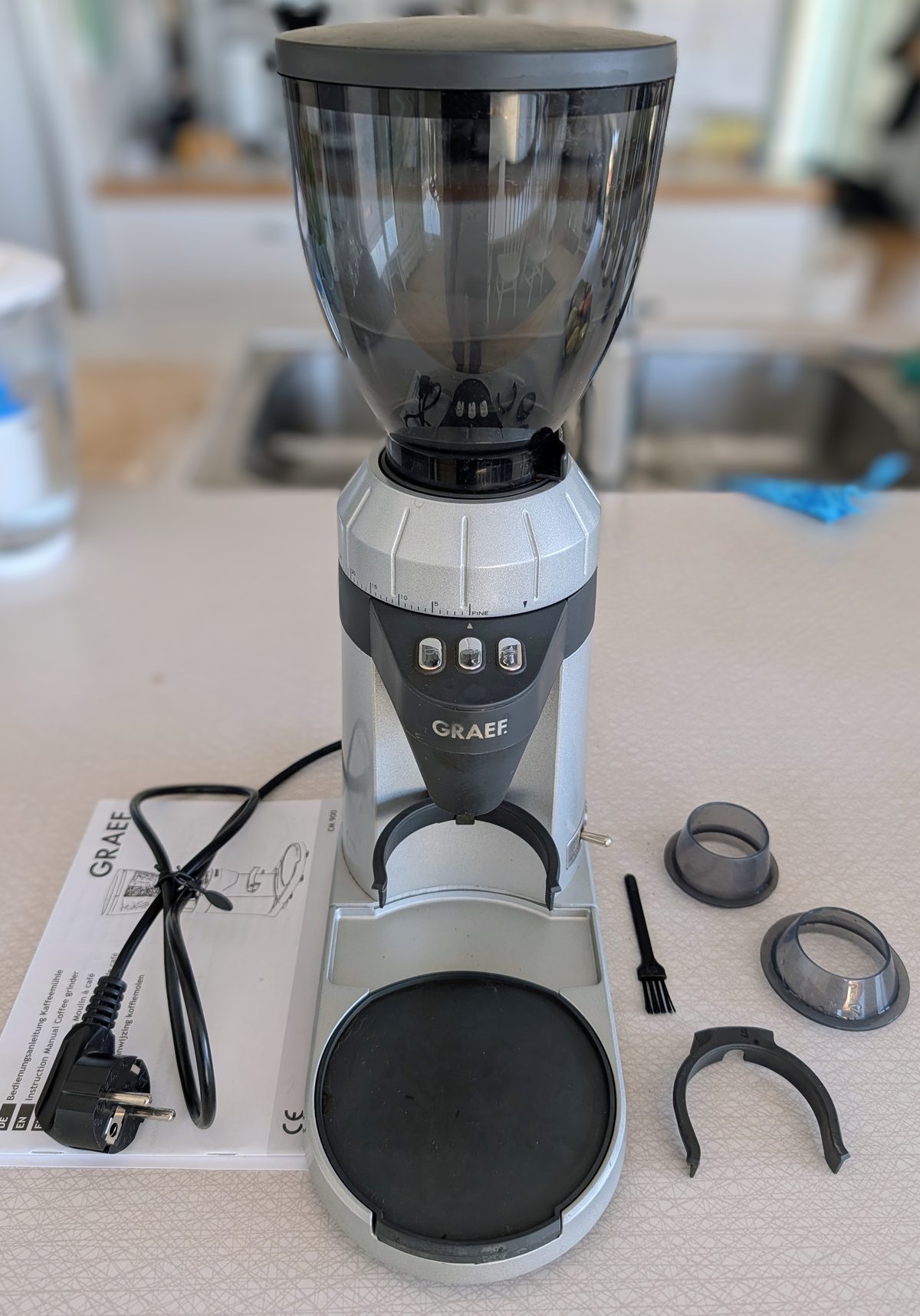
Graef CM900 — The First Grinder, and What It Taught Me About Grinders
Published 10 May 2026 · Updated May 2026
A well-built entry espresso grinder that did its job alongside the De'Longhi Dedica. Loud, and not the right match for a serious espresso machine — but a solid starting point that taught me what to look for in the next grinder.
Link updates to your region automatically
The Graef CM900 was my first grinder. I bought it after some research into entry-level espresso grinders — identifying the Graef as a quality German brand with a reputation for durable construction at a reasonable price. It did the job it was supposed to do alongside the De’Longhi Dedica EC685 for several years of daily use.
When the Sage Dual Boiler arrived, the mismatch was immediate. The grinder became clear as the constraint. I sold it for 400 SEK and bought the Eureka Mignon Specialità.
This is a short article about a stepping-stone purchase — and why the stepping-stone purchase taught something that the Eureka purchase later confirmed.
What I was looking for
The entry point into whole-bean espresso. I had been buying pre-ground coffee and wanted the freshness improvement that grinding immediately before brewing provides. The brief was a burr grinder capable of the espresso range, at a price that was reasonable for a first grinder without knowing how much this would matter to me.
The Graef CM900 fit the brief: it had conical steel burrs, stepped adjustment through the espresso range, solid German construction, and a price that didn’t require conviction about a hobby I had not yet fully committed to. I bought it to go with the Dedica and started learning.
What the CM900 is
A conical burr grinder with stepped adjustment and a design oriented toward entry espresso and filter coffee. The 40mm steel burrs produce a grind in the espresso range. The stepped adjustment provides a reasonable number of positions through the fine range — not stepless, meaning you choose between steps rather than landing exactly where you want, but adequate for learning.
The build quality was better than the price suggested. Graef is a German appliance brand with a long history, and the CM900 felt like a durable object — not premium, but not lightweight either. After years of daily use the grinder still worked mechanically without issue. The residual value on resale reflected this: 400 SEK after heavy use is genuine value recovery.
The main characteristic I noticed throughout ownership: the noise. The CM900 is loud in the way entry grinders often are — the motor and burr configuration produces more operational noise than quality flat-burr grinders at higher price points. Grinding three to four times per day, every day, this becomes part of the kitchen’s daily noise landscape. After switching to the Eureka Mignon Specialità with its ACE sound-dampening system, the difference was immediately apparent.
Ownership record
Bought approximately May 2021 alongside the Dedica. Sold December 2025 after the Eureka Mignon Specialità arrived.
Used daily — three to four coffees per day — through the full period of Dedica ownership and for a short period after the Sage arrived while the Eureka was on order. 400 SEK on resale.
How it performed
Alongside the Dedica: adequately. The combination produced acceptable espresso, but getting there required more fiddling than a well-designed grinder should need. Espresso is at the upper limit of what the CM900 can reliably do — fine grinds require working the adjustment to a point that borders on custom-fixing the setting rather than dialling in normally. Stepping one notch finer could go from the edge of the range to completely choked; stepping back produced something too coarse. The correct espresso grind lived in a narrow zone that required care to find and hold.
Over four years on this combination I learned the fundamentals — grind, dose, yield, tamping — but the grinder’s limitations were part of the learning rather than the platform for it.
The deeper limitation became visible when I had developed enough understanding to know what I was looking for. Stepped adjustment means the ideal grind for a given bean is sometimes between two positions. For an entry setup this is manageable. For a machine like the Sage Dual Boiler, where brew temperature and pre-infusion are dialled precisely, the imprecision in the grinder becomes the obvious constraint immediately.
What it taught
This is the real value of the CM900: it taught me what I needed in the next grinder.
After years of stepped adjustment, I knew I needed stepless. After the noise in daily use, I knew I wanted something quieter. After understanding extraction well enough to feel the particle distribution limitations of the entry burrs, I knew I needed 55mm flat burrs or larger. These were the specifications that led directly to the Eureka Mignon Specialità — not arbitrary upgrades, but requirements formed through understanding what the entry grinder lacked.
Buy the right grinder once and you spend more upfront and less overall. Buy the entry grinder first and you pay twice but you know exactly why the second grinder is right when you buy it. Both approaches have merit. The CM900 is the honest starting point for someone who doesn’t yet know what they need — and it teaches, reliably, what that is.
True cost of ownership
I estimate the purchase price at approximately 1,799 SEK (€164) — typical for the CM900 in Sweden at the time of purchase. Sold for 400 SEK (€36).
Net cost: approximately 1,399 SEK (€127) over four and a half years — around 300 SEK (€27) per year. As entry grinders go, the cost of learning was low.
Verdict
The right first grinder. Not the last, and not the one I would buy again now that I know what I need — but the right place to start when home espresso is new.
Loud, stepped, and limited when paired with a serious machine. Also solid, durable, worth 400 SEK on resale, and responsible for teaching me everything the Eureka Mignon Specialità needed me to already know.
True Cost of Ownership
| Metric | Value |
|---|---|
| Price paid | 1,799 SEK |
| Estimated lifespan | 8 years |
| Cost per year | 300 SEK |
| Budget alternative over same period | 0 SEK |
| Resale value (when sold) | 400 SEK |
Ownership record
Purchased May 2021 · Reviewed after 56 months of ownership
Good fit for
- ✓Entry-level espresso setups paired with a machine like the De'Longhi Dedica
- ✓Those who want a step up from pre-ground without spending 3,000+ SEK
- ✓Anyone starting their home espresso journey and learning to dial in
Not ideal for
- ✕Pairing with a serious espresso machine like the Sage Dual Boiler — the grind quality doesn't match the machine's precision
- ✕Those who are sensitive to grinder noise — the CM900 is audible
- ✕Long-term use in a setup that will grow toward quality espresso
Pros
- +Solid build quality for the price — held up well through years of daily use
- +Stepped adjustment covers the espresso range reasonably
- +Good value as an entry point — lower cost than the step up the grinder it competes with
- +Retains value on resale — sold for 400 SEK after years of daily use
Cons
- −Loud — noticeably louder than quality grinders at higher price points
- −Espresso is at the upper limit of what this grinder can reliably do — finer grinds require fiddling that borders on custom adjustment
- −Stepped adjustment limits dialling precision compared to stepless options
- −Particle size distribution is adequate for entry espresso, not matched to precision machines
Frequently Asked Questions
Is the Graef CM900 good for espresso?
It works for espresso, but espresso is essentially at the upper limit of what this grinder can reliably do. Getting a fine enough grind requires finding a narrow zone in the stepped adjustment where one notch can be the difference between too coarse and completely choked — and staying there requires care. It is workable, but it is not a grinder that makes fine-grind dialling easy. For filter coffee and coarser espresso it is more comfortable. For anyone who wants to push to finer grinds or use lighter roasts that demand a tighter extraction window, the CM900 will hit its ceiling quickly.
Why did you replace the Graef CM900?
When the Sage Dual Boiler arrived, the mismatch was immediate. The Sage has PID temperature control, adjustable pre-infusion, and precision that rewards a matched grinder. The CM900's stepped adjustment and somewhat inconsistent particle distribution were the ceiling — the grinder was limiting what the machine could deliver. The Eureka Mignon Specialità replaced it, and the difference was clear from the first shots.
How loud is the Graef CM900?
Loud enough to matter in daily use. Not unusable, but noticeably louder than quality flat-burr grinders at the 4,000–5,000 SEK range. In a kitchen in the morning, the CM900 grinds loudly enough to wake nearby family members. After switching to the Eureka Mignon Specialità — which has the ACE acoustic dampening system — the difference in daily quality of life was meaningful.
What did the Graef CM900 sell for?
400 SEK on the second-hand market. Reasonable residual value for an entry grinder after years of daily use. The CM900 is a durable enough product that buyers on the second-hand market can use it confidently — it works exactly as it did when new.
What grinder would you recommend instead of the Graef CM900?
For an entry setup paired with a machine at the Dedica level: the Graef CM900 is a sensible choice at its price. For anyone who knows they are heading toward a more capable machine and wants to avoid buying twice, starting with the Eureka Mignon Specialità (4,000–5,000 SEK / €364–455) is the better long-term decision. Buy the right grinder once rather than buying two grinders — a lesson this ownership taught directly.
Ownership Log
Sold alongside the De'Longhi upgrade
Sold the Graef CM900 when upgrading to the Eureka Mignon Specialità. It was in full working order — burrs were still sharp, the stepless adjustment still smooth. Got 400 SEK on Blocket. A grinder at this price point holding its resale value at roughly 22% after four years is about what to expect; the Specialità will do better given the build quality gap.