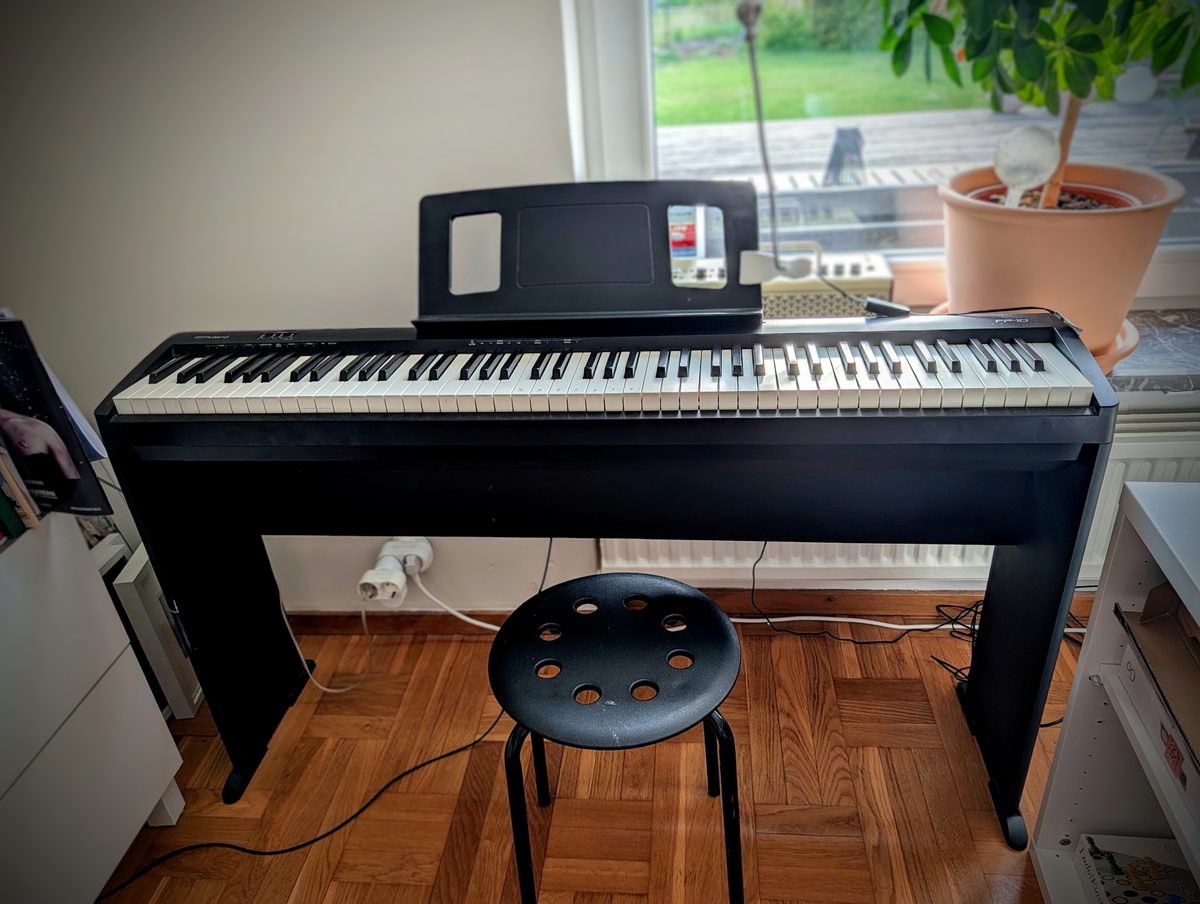
Roland FP-10 — The Right First Piano, Five Years On
Published 12 May 2026 · Updated May 2026
Five years of family piano learning on one instrument that has never needed a thought. The FP-10 is what the research said it was: the best value entry into weighted piano playing, built by a company that has been making piano action for decades.
August 2020. The brief was straightforward and the research made the decision relatively clear: we wanted to learn piano as a family, we wanted to make the instrument accessible to the children, and we wanted to do it properly rather than on a cheap keyboard that would teach the wrong habits.
The Roland FP-10 came out of the research as the consistent answer to a specific question: what is the least expensive digital piano where the weighted key action is genuinely good? It is not a close call. Five years later, it is still the instrument I would recommend to anyone asking the same question.
What I was looking for
The starting point was weighted keys, and this was non-negotiable. Learning piano technique on an unweighted keyboard builds muscle memory and touch habits that do not transfer to a real instrument. Dynamic control — the ability to vary volume and expression through how hard you press — requires an action that responds to touch. Unweighted keyboards produce the same note at the same volume regardless of how you press. That is not how a piano works, and it is not what we wanted to teach.
The second requirement was quality within a reasonable price. Weighted digital pianos range from around 4,000 SEK (€364) for the most basic options to 30,000 SEK (€2,727) and above for instruments approaching acoustic piano quality. The research question was: where does the quality become genuinely adequate for learning, rather than technically-weighted-but-not-really?
The answer was the Roland FP-10. At 5,735 SEK (€521) in August 2020, it uses Roland’s PHA-4 Standard action — the same action category, not the same budget substitute, as instruments costing significantly more. The sound engine is Roland’s SuperNATURAL system, which models acoustic piano tone with more accuracy than the samples-only approach of cheaper instruments. And critically: Roland has been building piano actions for decades. This is not a company entering the digital piano market. It is the company that many professionals use on stage.
The third factor was focus. The FP-10 does very little beyond being a piano. There is no screen, no extensive voice library, no built-in rhythms or arranger features. The controls are minimal. This initially seemed like a limitation and turned out to be a feature: the instrument presents itself as a piano, not as a keyboard workstation, and that framing is appropriate for learning.
What the FP-10 is
Eighty-eight keys, full size, weighted with Roland’s PHA-4 Standard action. The action is velocity-sensitive across the full range and responds to touch the way an acoustic instrument does. It is not the same as an acoustic piano — there is no escapement, no mechanical complexity of a grand action — but it is the correct entry into understanding what piano dynamics actually mean.
The SuperNATURAL sound engine models the resonance and decay of an acoustic piano rather than simply replaying recorded samples. At low volumes the difference from cheaper instruments is subtle. At higher volumes and with dynamic playing, the Roland sounds more natural — notes decay correctly, the instrument responds to velocity with the kind of variation that makes playing musically interesting rather than mechanically uniform.
The instrument connects via USB to any computer, phone, or tablet for MIDI, and via Bluetooth MIDI to learning apps. It has no internal amplification that would work in a large room, but through headphones or external speakers the audio is excellent.
Five years of family use
Bought August 2020. Used continuously since then — children and adults, daily in periods of active learning, less frequently in quieter periods, always available.
We started with Marvel Piano when the children were younger: the FP-10’s accurate key sensing meant the app received proper velocity data, and the learning feedback loop worked as it should. We have since moved to Yousician for both piano and guitar learning, and the integration is the same — the piano communicates accurately, and the app can teach dynamically rather than just note identification.
Five years in, the instrument performs identically to how it performed in the first week. The weighted action has not loosened or changed character. The sound quality is unchanged. Nothing has required service or attention. This is what Roland’s reputation for build quality means in practice: there is nothing to report because nothing has gone wrong.
The feature-minimal argument
The FP-10 is sometimes criticised for having too few features. It is worth addressing this directly because the criticism misunderstands the product.
Learning piano requires learning to play piano. It does not require rhythms, backing tracks, a library of voices, or a built-in recorder during the early years. These features exist on more expensive keyboards and some of them are genuinely useful at an advanced stage. At the beginning, they are distractions. The FP-10 presents a piano. You learn to play it. The simplicity of the proposition is appropriate to the stage of the learning curve it serves.
When a more capable instrument is needed, the FP-10 will have taught the technique that makes a more capable instrument worth having.
True cost of ownership
5,735 SEK (€521) at purchase in August 2020. At fifteen years of expected life — conservative for a well-built digital piano with Roland’s reliability record — the annual cost is 382 SEK (€35).
The comparison is instruments with equivalent action quality: the next step up from the FP-10 in Roland’s own range is the FP-30X at around 8,500 SEK (€773). Instruments from other makers at similar quality levels fall in the same range or higher. There is no meaningfully better instrument at lower cost for a learner’s first weighted piano — the FP-10 represents a price floor, not a compromise.
The resale market confirms the value. A well-maintained FP-10 sells for 55–65% of original price and moves quickly. The net cost of ownership over the full period, accounting for eventual resale, will be considerably below the purchase price.
Verdict
The research said this was the right first piano at this price point. Five years of family use has not provided a single reason to disagree.
Proper weighted action. Roland sound quality. No unnecessary features competing for attention. Built to last and demonstrably lasting. At 382 SEK (€35) per year over a fifteen-year horizon, this is the clearest possible entry into piano learning for a family that wants to do it properly.
The right first piano. Still the right first piano.
True Cost of Ownership
| Metric | Value |
|---|---|
| Price paid | 5,735 SEK |
| Estimated lifespan | 15 years |
| Cost per year | 382 SEK |
| Budget alternative over same period | 18,000 SEK |
| Net saving vs. budget alternative | 12,265 SEK |
Ownership record
Purchased August 2020 · Reviewed after 57 months of ownership
Good fit for
- ✓Families starting piano learning who want a real instrument, not a toy keyboard
- ✓Anyone who wants weighted keys at the lowest price point where the action is genuinely good
- ✓Learning alongside apps — Marvel Piano, Yousician, Simply Piano all work well
- ✓Those who want Roland build quality without paying for features they will not use
Not ideal for
- ✕Advanced players who need 88 weighted keys with escapement action — this is entry level
- ✕Those who need onboard speakers powerful enough to fill a large room
- ✕Anyone who wants a large feature set: the FP-10 is deliberately minimal
Pros
- +Roland PHA-4 Standard weighted key action — the correct feel for learning proper technique
- +88 keys, full size, no shortcuts on the instrument itself
- +Roland's SuperNATURAL piano sound — noticeably better than competitors at this price
- +Five years of family daily use without fault or degradation
- +Strong resale value — Roland digital pianos hold their price well
Cons
- −Onboard speakers are adequate but not impressive — a stand with external speakers improves the experience
- −Minimal controls — no screen, few buttons, app-dependent for deeper settings
- −No sustain pedal included — needs to be purchased separately
Frequently Asked Questions
Is the Roland FP-10 good for beginners learning piano?
Yes — and weighted keys are the reason. Learning piano technique on an unweighted keyboard builds habits that do not transfer to a real instrument. The FP-10's PHA-4 Standard action responds to touch and velocity the way an acoustic piano does: press softly and you get a quiet note, press firmly and you get a loud one. This is fundamental to learning dynamics and expression, and it is not present on unweighted or semi-weighted keyboards. The FP-10 is the lowest price point where Roland's weighted action is genuinely good rather than merely present.
How does the Roland FP-10 compare to other entry-level digital pianos?
The consistent finding in research was that the FP-10 outperforms its price point significantly. Competing weighted keyboards at similar prices — Casio CDP-S series, Yamaha P-45 — are competent, but the Roland's action and sound quality consistently come out ahead in side-by-side comparisons. The instruments that clearly surpass the FP-10 in action quality cost 8,000–12,000 SEK (€727–1,091) or more. For the gap between the FP-10 and those instruments, the FP-10 is the answer for most learners.
Can the Roland FP-10 be used with Yousician or other piano learning apps?
Yes — we have used it with both Marvel Piano (when the children started) and Yousician (currently). The FP-10 connects via USB-MIDI or Bluetooth MIDI to any learning app. The key sensing on the weighted action means the apps receive accurate velocity data — the piano communicates how hard you are pressing, which apps use for scoring and feedback. An unweighted keyboard gives the app consistent velocity data regardless of touch, which defeats part of the learning feedback loop.
Is the Roland FP-10 worth buying in 2026?
Yes. The FP-10 has been updated slightly since our 2020 purchase but the core remains the same: PHA-4 Standard action, SuperNATURAL sound, 88 keys. The value proposition has not changed. It remains the standard recommendation for entry-level weighted piano because Roland has not compromised the fundamentals to hit the price point — they have simply removed features (screens, extra voices, onboard rhythms) that beginners do not need anyway. Buying stripped-back is a feature, not a limitation, at this stage of learning.
What is the resale value of the Roland FP-10?
Good. Roland digital pianos hold their value on the second-hand market better than many competitors. An FP-10 in good condition typically sells for 55–65% of original purchase price, and it tends to move quickly — the combination of Roland quality and entry-level price point means there is consistent demand from new buyers. This is part of the total cost of ownership calculation: the net cost after eventual resale is significantly lower than the purchase price.