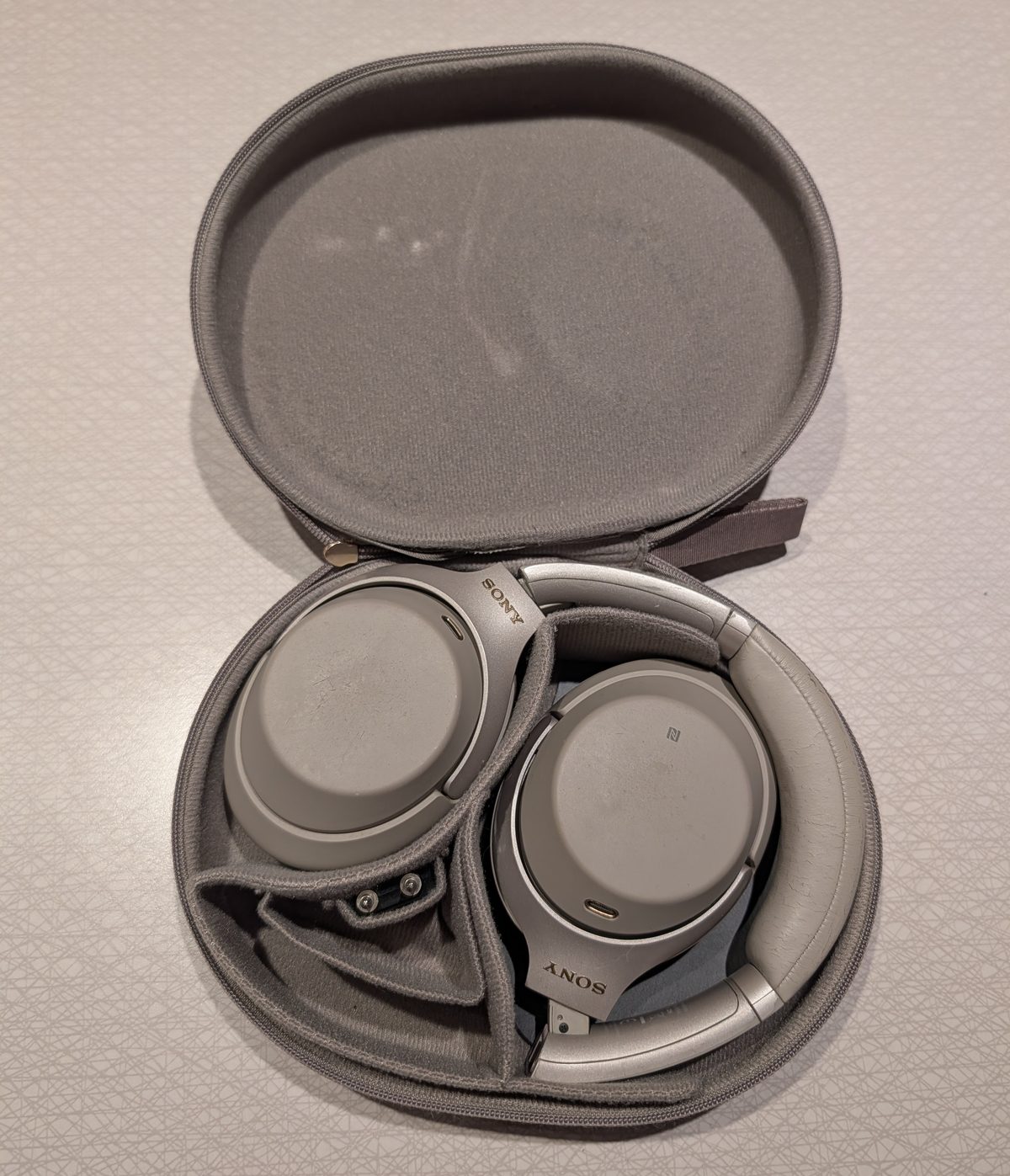
Sony WH-1000XM3 — Five Years On and Still the Best Sound in the House
Published 10 May 2026 · Updated May 2026
Five years in, still the best audio in the house. Bought in February 2020 for 2,499 SEK (€227). Fantastic sound and comfort from day one, noise cancellation that remains a reference point, and a battery that has not shown meaningful degradation. The only annoyance: re-pairing when switching between devices.
Link updates to your region automatically
I bought the Sony WH-1000XM3 in February 2020 for 2,499 SEK (€227) in silver, and they have been the reference point for audio quality in this household ever since. Five years of regular use later, they still work exactly as they did on day one. Fantastic sound. Excellent comfort for long sessions. Noise cancellation that, when I first used it properly on a commute, genuinely stopped me and made me realise what I had been missing.
The eventual purchase of the Soundcore Liberty 4 NC earbuds was not a replacement decision. These headphones are not going anywhere.
What I was looking for
The brief was over-ear wireless noise cancellation — specifically for desk use and commuting. I had been using wired headphones and wanted to remove the cable without compromising audio quality. The Sony WH-1000XM3 had, by early 2020, established itself as the benchmark in its category: the noise cancellation was widely considered best-in-class, the sound quality was praised as genuinely warm and detailed rather than consumer-tilted, and the comfort was consistently noted as something you could wear for hours.
I bought them in silver — the less common colour option — because I preferred the visual weight. A small thing, but after five years of looking at them daily, I have no regret about the choice.
What makes these headphones the reference
The noise cancellation. In 2020 this was the clearest advantage over any competitor at the price: the Sony QN1 chip produced active noise cancellation that reduced continuous low-frequency noise — aircraft cabin noise, road noise, HVAC — to near-silence. Five years later, with the XM5 and Bose QuietComfort 45 now in the market, the XM3 ANC is still competitive. It was ahead of its time at purchase.
The sound quality. The XM3 has a warm tuning — slightly elevated bass, smooth midrange, extended but not fatiguing treble. For music this is the right choice for long listening: detailed enough to hear the recording clearly, not clinical enough to feel like a monitoring tool. I have listened to everything from orchestral recordings to electronic music on these and the tuning has been the right one for everything. Over five years I have not found the sound character to be wrong for anything I wanted to listen to.
The comfort. Over-ear headphones are an exercise in fit quality — how the ear cup aligns, how the headband pressure distributes, how the clamping force relates to the weight. The XM3 gets this right. I can wear them for three or four hours without fatigue. For long desk sessions or flights this is the primary practical quality.
Ownership record
Bought February 2020. 2,499 SEK (€227) approximately (I do not have the exact receipt, but this was the typical retail at the time).
Still owned and in regular use. Not sold. No intention to sell.
Build quality
Five years in: the ear cushions show real wear — the surface material has worn down in places and the foam has compressed from new. They are still comfortable and fully functional; there is no structural failure, and I do not feel the urge to replace them. But the wear is visible and honest — these are five-year-old headphones that have been used regularly, and they look it in places.
The silver finish on the headband and cups has also worn slightly in spots where handling is repeated. Nothing that affects use, but worth stating plainly.
The hinge mechanism is solid — no looseness, no creak in the fold. The build is predominantly plastic, which is the right choice for a product that needs to be light for long wear, and the structure itself has held up without issue. Fully functional and still comfortable is the accurate summary.
How they perform
The sound quality is the consistent highlight. Across five years of regular use, the XM3 has been the best audio experience available in this household — clearer than the Moccamaster comparison is for coffee, the headphones set the reference against which everything else gets compared.
The noise cancellation in 2025 use: still the primary reason to put them on for focused work. In an open-plan environment or on public transport, they reduce ambient noise to a level where I can think without effort. The XM5 and competing products have closed the gap somewhat since 2020, but the XM3 remains effective rather than outdated.
The device switching problem
The XM3’s one genuine shortcoming, and it is worth stating clearly: the headphones do not support multipoint connection. They remember multiple paired devices, but only one can be active at a time. To switch from laptop to phone, I need to either disconnect on the laptop and connect on the phone, or hold the power button to enter pairing mode and select the other device. This takes thirty seconds to a minute and breaks the flow of use.
By 2020 standards this was not unusual. By 2026, with multipoint connection standard on most premium and mid-range competitors, it is the feature gap that makes the XM4 a legitimate upgrade for anyone who switches between devices regularly. I manage it — I use the headphones primarily on one device at a time, with the Soundcore earbuds handling the casual multi-device situations. But if I were buying today, the XM4 would be the choice for this reason alone.
Why I also bought the Soundcore Liberty 4 NC
This is worth explaining directly because the two products sit on the same site. The XM3 is the right product for extended focused listening — at a desk, on a flight, in any context where I want the best possible audio quality and noise cancellation and have room for over-ear headphones. The Soundcore Liberty 4 NC answered a different question: what goes in my pocket for daily casual use.
These are not competing products. They are different tools for different contexts. The XM3 stays. The earbuds come everywhere.
Verdict
Five years of use, still the best audio in the house. Bought in February 2020 for around 2,499 SEK (€227), in silver, and I have not once thought about replacing them for sound quality reasons.
The device switching is the one real friction — a software limitation in an otherwise excellent product. I work around it. For long listening sessions at a desk or on travel, these remain the right choice.
Not sold. Not planning to sell. Will continue in use until the battery genuinely degrades or a clear successor demands the change. At this point, five years in, neither condition is close.
True Cost of Ownership
| Metric | Value |
|---|---|
| Price paid | 2,499 SEK |
| Estimated lifespan | 8 years |
| Cost per year | 312 SEK |
| Budget alternative over same period | 2,499 SEK |
Ownership record
Purchased February 2020 · Reviewed after 75 months of ownership
Good fit for
- ✓Long listening sessions at a desk or during travel where over-ear comfort matters
- ✓Those who use one primary audio device most of the time
- ✓Anyone who values deep noise cancellation for focus work or commuting
- ✓Listeners who want reference-quality wireless audio at a price that's aged well
Not ideal for
- ✕Those who switch frequently between devices (the lack of multipoint memory is a real friction)
- ✕Portable daily use where pocketability matters — for that, see the Soundcore Liberty 4 NC
- ✕Gym or sport use — these are not built for physical activity
Pros
- +Sound quality that remains a clear reference point five years after purchase
- +Noise cancellation that substantially outperformed the market in 2020 — still competitive
- +Over-ear comfort for extended sessions — no fatigue after hours of wear
- +Battery still performing well at five years of regular use
- +Bought in silver — still looks clean and presentable
Cons
- −No multipoint connection memory — switching devices requires active re-pairing each time
- −Over-ear form factor means they do not go in a pocket — a category limitation, not a defect
- −Not resoleable or repairable in the way mechanical products are — sealed electronics with battery
Frequently Asked Questions
Is the Sony WH-1000XM3 still worth buying in 2026?
The XM3 has been discontinued in favour of the XM4 and XM5. If you can find a used or remaining-stock unit, the audio quality and ANC remain competitive. The XM4 added multipoint connection (the main XM3 shortcoming) and slightly improved ANC; the XM5 refined the design further. For a new purchase, the XM4 or XM5 are the current recommendations. For anyone who owns an XM3: there is no performance reason to upgrade unless the device-switching limitation has become genuinely painful.
How does the XM3 compare to the XM4 and XM5?
The XM4 is the direct successor and addresses the XM3's main weakness: it has multipoint connection, meaning it remembers two devices and switches between them automatically. ANC is marginally improved. Sound quality is comparable. The XM5 further improved ANC depth and refined the design but is significantly more expensive. For owners of an XM3, the upgrade case is modest unless device switching is the primary pain point.
Why did you buy the Soundcore Liberty 4 NC if the XM3 still works?
Different form factors for different purposes. The XM3 is an over-ear headphone — the right choice for long desk sessions, travel, and focused listening where the over-ear isolation and comfort matter. It does not fit in a pocket. The Soundcore Liberty 4 NC is a true wireless in-ear earbud — pocketable, unobtrusive, and suited to the casual daily use where carrying headphones is not practical. I use both. The XM3 stays at the desk or goes in a bag; the Soundcore goes everywhere else.
How is the battery after five years?
Still performing well. I have not noticed a meaningful reduction in playback time from the rated 30 hours. Over-ear headphones have larger battery cells than earbuds, which degrades more slowly over charge cycles — the surface-area-to-capacity ratio is more favourable. Five years of regular (not daily) use has not produced audible battery degradation. This contrasts with in-ear earbuds, where battery degradation at 18–30 months is common.
What is the main drawback of the Sony WH-1000XM3?
The device switching. The XM3 holds one paired device in active memory — when you switch from laptop to phone, you need to either disconnect on the laptop and reconnect on the phone, or manually enter pairing mode. This is a three-step process that breaks the flow of use. In 2020 this was acceptable; by 2026, with multipoint connection standard on most competitors, it is the one feature that makes the XM4 or XM5 a meaningful upgrade for anyone who switches devices frequently.
Ownership Log
Five years on — still the daily driver at the desk
Over five years since purchase and the XM3 still functions exactly as it did on day one. No battery degradation I can notice in daily use. The ear cushions show real wear — the surface material has worn down in places and the foam has compressed — and the finish has worn slightly on the headband where handling is most frequent. None of this affects function or comfort; they are still comfortable for long sessions. The noise cancellation remains genuinely impressive. The device-switching annoyance has never been fixed — still requires manually re-pairing when switching between devices. Fully functional, visibly used, no reason to replace them.