Wolverine 1000 Mile Boots — Thirteen Years of Nordic Winters and Still Going
Published 10 May 2026 · Updated May 2026
Thirteen years of Nordic fall and winter use and the leather has only gotten better. At roughly 145 SEK (€13) per year of ownership, these are the last boots I intend to buy.
Link updates to your region automatically
Thirteen years ago I walked into a shoe shop on Storgatan in Malmö — the shop is gone now — and paid around 2,100 SEK (roughly €185 at the time) for a pair of boots that were listed at close to double that. I was not looking for a heritage piece or a collector’s item. I needed boots that could handle a Nordic fall and winter, look presentable enough for daily use, and last longer than two or three years.
These are still the boots I reach for.
What I was looking for
The brief was simple: all-round boots for fall and winter in Sweden. Something that looked good without being purely formal. Something durable. I had been through enough pairs of mid-range boots to understand that anything below a certain threshold of construction quality tends to fail at the sole — glued soles separate, synthetic uppers crack, and within three years you are back at the shop making the same decision again.
The Wolverine 1000 Mile was on a 40–50% discount at the Storgatan shop. The credentials were immediately visible: serious leather, welt stitching you could see running around the entire sole, American manufacturing with a brand history going back to 1914. At that price, with those credentials, I did not need much more convincing.
What makes these boots different
The 1000 Mile is built around two things that matter for longevity: the leather and the construction.
The leather is Horween Chromexcel, produced by the Horween Leather Company in Chicago — a tannery established in 1905. Chromexcel is tanned over several weeks with a blend of oils, waxes, and beef tallow. The process makes the leather naturally water-resistant from the start, self-healing for minor scuffs, and able to develop a deep patina with age rather than fading or cracking. It is among the finest boot leather made anywhere in the world — the quality that you might associate with the best Italian tanneries, just made in the American Midwest.
The construction is a Goodyear welt. This is the detail that separates a boot you can keep for twenty years from one you discard when the sole gives out. In a welted boot, the upper, a strip of leather called the welt, and the sole are all stitched together — no structural glue. When the sole wears through, a cobbler stitches on a new one. The boot continues. A glued boot is finished when the sole fails. The Goodyear welt is the reason these boots are still worth maintaining after thirteen years; a cheaper alternative would be in landfill.
Wolverine has made the 1000 Mile since 1914. The name was their original quality guarantee — a boot built to last 1,000 miles of hard wear.
Ownership record
Purchased at a shoe shop on Storgatan in Malmö, now closed. Approximately 2012–2013.
Listed price at the time: around 4,200–4,500 SEK (€370–390). Paid approximately 2,100 SEK (€185) after a 40–50% discount.
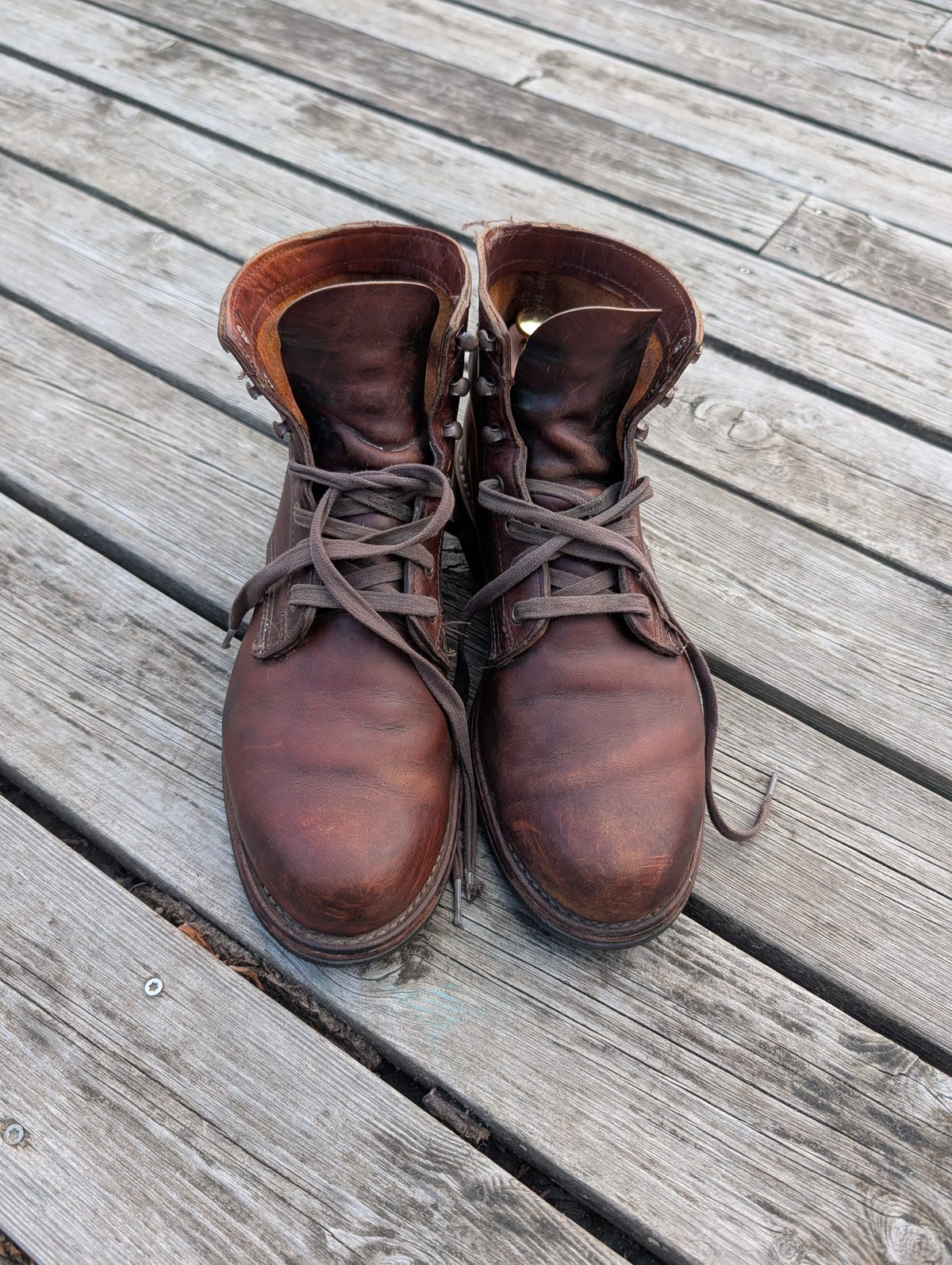
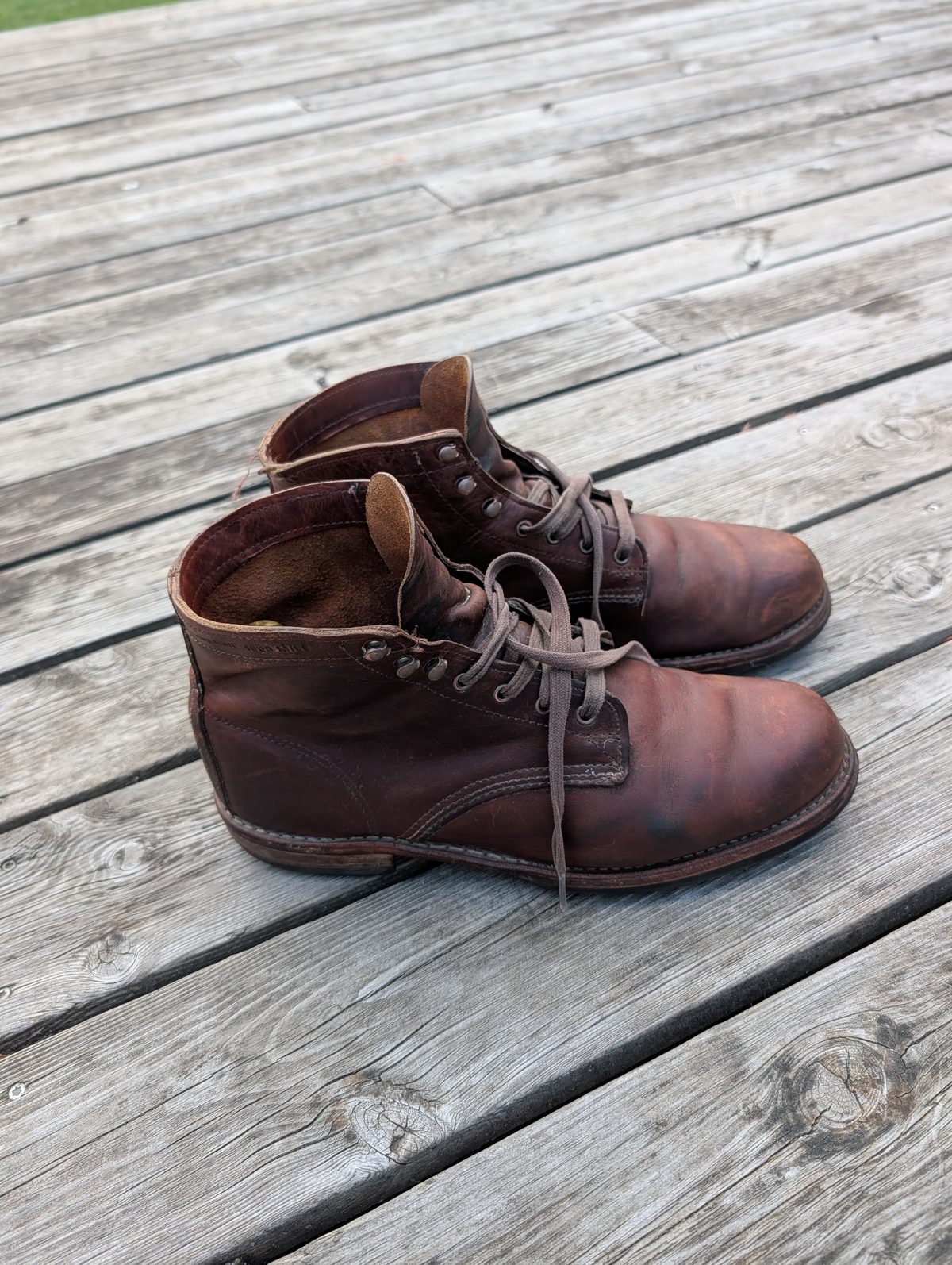
The photographs in this article are the actual boots after a proper care session — cleaned, treated with Saphir Renovateur, and finished with Médaille d’Or. This is exactly what you should do with Chromexcel leather periodically, and the boots respond to it visibly. They look fantastic. Thirteen years in, properly cared for, they look better than most new boots on a shelf — the patina deepens with use and the leather only improves with conditioning. More use makes them look more fantastic, not less.
Build quality
A new pair of 1000 Mile boots is stiff — noticeably, almost stubbornly so. This is the material behaving correctly. In the first weeks the boots creak and resist the foot. By month two they have started to conform to it. By the end of the first year the leather insole has shaped to your foot in a way that nothing off a shelf can replicate.
Thirteen years in: the welt stitching is intact along the entire perimeter. The brass eyelets are solid — none have loosened or torn through. The heel counter is still holding its shape. The uppers have developed a deep, mottled brown patina — darker at the flex points across the toe box, lighter where the leather has taken polish — but there is no cracking anywhere. The structure is what it was.
How they perform
These are all-round boots and that is exactly how I have used them. Nordic falls and winters: wet leaves, city slush, cold rain, the occasional light snow. Daily use through autumn and winter seasons for over a decade.
Horween Chromexcel handles moisture better than its appearance suggests. The tanning process leaves it naturally resistant — water beads on a conditioned pair. I have never had them soak through in normal weather conditions.
The comfort, once broken in, is the thing that is hardest to explain. A leather insole that has shaped to a specific foot over thirteen years is something you notice when you put on another boot. These have become the reference point against which I judge everything else.
After thirteen years
I use Saphir Renovateur to clean and condition and occasionally Saphir Médaille d’Or cream — both excellent French leather care products and about the best you can use on leather this good. Before taking the photos for this article I gave them a proper session with both — they deserved it after thirteen years, and they had earned a decent photograph. But that is also all the care they have ever received: occasional, not obsessive. This is how they have looked throughout, and how they look now.
The patina is real — the leather has darkened and deepened from what was originally a medium brown, developing the characteristic Chromexcel mottling where different areas have absorbed differently. It looks, honestly, considerably better than it did when new. That is not something you can say about most things after thirteen years of regular use.
The soles show wear but remain structurally sound. I have not resoled them yet. When that time comes, a cobbler can replace the sole and these boots have another decade in them.
True cost of ownership
The maths here is worth making explicit, because it is the argument the sticker price obscures.
A typical mid-range boot at around 1,300 SEK (€115) lasts roughly three years before the sole gives out or the upper cracks. Over twenty years that is around seven pairs, approximately 9,100 SEK (€800) spent, seven purchase decisions, and seven break-in periods. Each replacement is also a worse outcome than the previous boot, because a glued sole at three years is not a choice — it is a failure.
The Wolverines at 2,100 SEK (€185) on sale, with one resole of roughly 800 SEK (€70) somewhere in the middle, comes to around 2,900 SEK (€255) over twenty years. That is 145 SEK (€13) per year against 455 SEK (€40) per year for the alternative. The quality boots cost three times less annually — and the experience of wearing them is categorically better.
There is also resale value. A well-maintained pair of 1000 Mile boots in good condition sells on Blocket for 1,000–2,000 SEK (€91–182) depending on size and condition. A worn-out mid-range boot is worth nothing.
One purchase, not seven
There is a version of sustainability that is about materials and manufacturing. Horween Chromexcel leather is a natural material processed without synthetic coatings; a Goodyear-welted sole is stitched, not glued with petrochemical adhesives; the boot can be repaired rather than discarded. That matters.
But the simpler version is this: one pair of boots over twenty years is one object manufactured, shipped, and eventually disposed of — against seven pairs over the same period. Seven times the raw material, seven times the factory energy, seven times the packaging and transport. Buying well once is the most straightforward sustainable consumer choice available, and it also happens to be the cheaper option per year. The environmental and financial arguments point in the same direction.
Verdict
The shop on Storgatan where I bought these is gone. The boots are not.
At 2,100 SEK on sale, against thirteen years of use and counting, this was one of the better purchasing decisions I have made — not because I planned it that way, but because the construction made it inevitable. A Goodyear-welted boot in Horween Chromexcel, bought from a brand that has been making the same boot since 1914, was always going to outlast whatever I would have bought instead.
The only cost still ahead of me is a cobbler visit and perhaps another tin of Saphir.
True Cost of Ownership
| Metric | Value |
|---|---|
| Price paid | 2,100 SEK |
| Estimated lifespan | 20 years |
| Cost per year | 145 SEK |
| Budget alternative over same period | 9,100 SEK |
| Net saving vs. budget alternative | 7,000 SEK |
Ownership record
Purchased January 2013 · Reviewed after 160 months of ownership
Good fit for
- ✓Nordic fall and winter daily wear
- ✓Anyone who wants one pair of boots that handles everything
- ✓People with a 10+ year horizon on footwear
- ✓Those willing to spend once rather than replace repeatedly
Not ideal for
- ✕Buyers who rotate footwear styles frequently
- ✕Anyone wanting immediate comfort — break-in is real
- ✕Heavy outdoor or hiking use
Pros
- +Horween Chromexcel leather develops a patina that only improves with age
- +Goodyear welt means the sole can be replaced indefinitely
- +Naturally water-resistant — handles Nordic winters with minimal maintenance
- +After break-in, the fit is something cheaper boots cannot replicate
- +Structurally intact after 13 years with only occasional care
Cons
- −Six-week break-in period of genuine stiffness
- −Requires occasional conditioning — not much, but some
- −Full retail (4,500 SEK / ~€390) is a significant upfront commitment
Frequently Asked Questions
Are Wolverine 1000 Mile boots worth the price in Sweden?
At full Swedish retail around 4,500 SEK (€390), they demand a serious upfront commitment. Bought at a 40–50% discount — which was possible from specialist retailers — the TCO case is clear: roughly 145 SEK (€13) per year over 20 years, against 455 SEK (€40) per year replacing a 1,300 SEK boot every three years.
How do Wolverine 1000 Mile boots hold up in Swedish winters?
Well. Horween Chromexcel is heavily waxed during tanning and resists water naturally. An occasional coat of Saphir Renovateur before winter handles the rest. They are not rubber boots — deep sustained slush is not their environment — but Nordic street winters for thirteen years have not troubled them.
What is Horween Chromexcel leather?
Chromexcel is a full-grain leather made by the Horween Leather Company in Chicago — a tannery established in 1905 that supplies many of the most respected footwear brands in the world. It is tanned over several weeks with oils, waxes, and beef tallow, making it naturally water-resistant, self-healing for minor scuffs, and able to develop a deep patina with age rather than fading or cracking.
Can Wolverine 1000 Mile boots be resoled?
Yes — this is central to the TCO case. The Goodyear welt stitches the upper, welt strip, and sole together without glue. Any competent cobbler can replace the sole with leather, rubber, or crepe. A full resole costs roughly 700–1,000 SEK (€60–90). The welt itself can also be replaced if needed. This is what makes a welted boot a 20-year proposition.
How much maintenance do they actually need?
Less than you would expect. I use Saphir Renovateur to clean and condition, and occasionally Saphir Médaille d'Or cream. But I have not been meticulous about it — perhaps twice a year, sometimes less. After thirteen years the leather shows no cracking and the patina looks better than the boots did when new. The leather largely maintains itself.
Ownership Log
13 years in — leather better than new
Thirteen years of Nordic fall and winter use. The Chromexcel leather has developed a deep patina that no new boot can replicate — it absorbs conditioner readily and the surface has that slightly waxy, lived-in character that Horween leather is known for. Recently cleaned, treated with Saphir Renovateur, and finished with Médaille d’Or — the response to proper care is immediate and visible. They look fantastic. The welt is solid, the sole has been replaced once, no stitching failures, no structural issues. The leather only gets better with more use and the right maintenance.