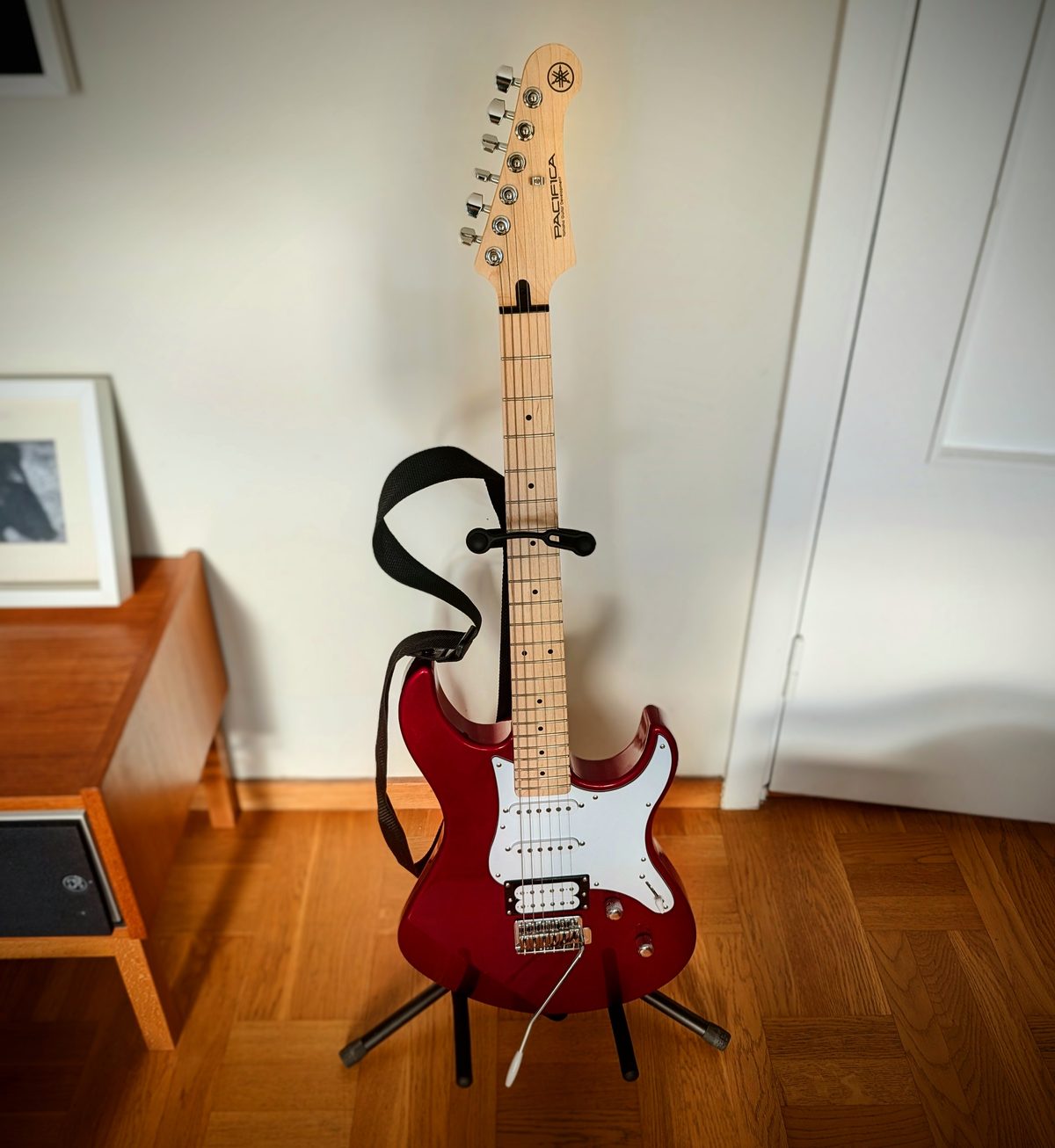
Yamaha Pacifica 112VM — The Guitar That Grows With You
Published 12 May 2026 · Updated May 2026
The guitar the research consistently points to, and four months in it is exactly what was promised: well built, great to play, works for children and adults, and good enough that you will not need to replace it when you improve. At 170 SEK (€15) per year over twenty years, it is the obvious choice.
January 2026. The guitar came first. The amp decision followed once the instrument was chosen — but the starting point was here, and the brief was the same as it always is with this kind of purchase: research it properly, buy the right thing once, and avoid the trap of a cheap instrument that teaches frustration instead of technique.
The Yamaha Pacifica 112VM is what the research pointed to, with a consistency that made the decision straightforward. It is not the cheapest option. It is also not close to the most expensive. It is the guitar that every serious discussion of entry-to-mid level electrics identifies as the benchmark: well-built, properly playable, good enough to stay relevant when you improve.
Four months in, it is exactly that.
What I was looking for
The instrument decision started with a category choice: electric rather than classical. This is worth explaining because it is not obvious to everyone starting out.
Classical guitars — the ones with nylon strings and a wide neck — are the traditional recommendation for beginners and have real strengths for certain styles. But for general guitar learning aimed at the kind of playing Yousician teaches — pop, rock, fingerpicking, chords — they have practical disadvantages. The neck is wide and makes chord shapes harder to reach for smaller hands. The strings are further from the fretboard and require more pressure. The technique is specific and does not transfer to other styles without adjustment.
Electric guitars have lighter steel strings, lower action, and narrower necks. For a family where both children and adults are learning, and where the goal is playing accessible music rather than classical repertoire, electric is the more accessible starting point. This was also the decision that shaped what amp came next.
The second requirement was quality. The beginner guitar market is full of instruments that are technically functional but that make learning harder than it should be. Poorly cut nuts, high action, inconsistent fretwork — these are not problems you can hear on the shelf but you feel immediately when you try to play. They cause physical frustration and slow learning. The research question was: at what price point does the quality become reliably right?
Why the Pacifica
The Yamaha Pacifica 112 series has been in continuous production since 1993, and the reason it is still the standard recommendation three decades later is that Yamaha has maintained the quality at the price. This is not a low-cost outsourced product that happens to carry a recognisable name. The Pacifica is a deliberate instrument, built to a specification that Yamaha has refined over decades.
Yamaha’s quality control in the 112 range is exceptionally consistent. Where cheap guitars vary between individual examples — some acceptable, some poor — Pacificas are reliably the same. When people recommend the Pacifica in guitar communities, they are not recommending a specific lucky example they happened to find. They are recommending a product that delivers consistently.
The 112VM variant specifically has a maple fingerboard where other 112 models use rosewood or pau ferro. Maple is harder-wearing, does not require conditioning, and has a slightly brighter tonal character. The VM also has a bound neck — a small refinement that improves the feel at the neck edges. These are not transformational differences, but across a range where all the models are good, the VM is a small step ahead on materials.
The guitars are also considered good well beyond the beginner stage. This was a consistent finding in the research: players who learned on a Pacifica and went on to develop real skills often kept the guitar rather than replacing it. It grows with the player. The upgrade trap — buy cheap, outgrow it, buy again — does not apply in the same way it does with budget instruments.
Four months of ownership
Bought January 2026, at the same time we began using Yousician properly. Used by adults and children, for learning via app and for playing independently.
The guitar played well out of the box — the fretwork is clean, the intonation is close, and the action is appropriate for a learner without being frustratingly high. A basic setup would fine-tune this further, but it was immediately usable.
For children, the lighter strings and accessible neck make chord formation achievable from early in the learning curve. For adults, the instrument is comfortable and does not impose limitations on technique. Both have used it without complaint about the instrument itself — which is exactly what you want at this stage. The tool should be invisible. The guitar has been invisible.
True cost of ownership
3,390 SEK (€308) at purchase. At twenty years of expected life — conservative for a well-maintained electric guitar, which can last indefinitely — the annual cost is 170 SEK (€15).
The comparison with a cheap starter guitar at 1,200–1,500 SEK (€109–136): a budget instrument that does not play correctly, needs replacing when you improve, and has no resale market comes to 2,400–3,000 SEK (€218–273) over two replacement cycles — for a worse experience throughout. The Pacifica costs more and costs less.
The resale value reinforces this. A well-maintained 112VM in good condition sells for 55–65% of purchase price. The actual net cost of the Pacifica over the ownership period is significantly lower than the sticker price, and at each point in the ownership it is the better guitar.
Verdict
The guitar the research consistently identified, and four months in it has delivered what the research promised.
Built well enough that it will not need replacing when you improve. Light enough for children, complete enough for adults. 170 SEK (€15) per year over twenty years. The right first guitar, bought once.
True Cost of Ownership
| Metric | Value |
|---|---|
| Price paid | 3,390 SEK |
| Estimated lifespan | 20 years |
| Cost per year | 170 SEK |
| Budget alternative over same period | 3,500 SEK |
| Net saving vs. budget alternative | 110 SEK |
Ownership record
Purchased January 2026 · Reviewed after 4 months of ownership
Good fit for
- ✓Anyone starting guitar who wants to learn on a proper instrument rather than a toy
- ✓Families where both adults and children will use the same guitar
- ✓Those who want to avoid the upgrade trap — a guitar that stays relevant as you improve
- ✓Learning with Yousician or other apps where a responsive, well-intonated guitar matters
Not ideal for
- ✕Those who specifically want a classical or acoustic guitar
- ✕Players at an advanced level looking for a specialist instrument with specific character
- ✕Anyone who wants a guitar already set up for a particular playing style out of the box
Pros
- +Yamaha's build quality at this price point is exceptional — consistent across the range
- +Maple fingerboard on the VM variant adds brightness and durability over rosewood alternatives
- +Lighter strings and smaller body than classical guitars — genuinely easier to learn on
- +Not just a beginner guitar: skilled players find it holds up well beyond the learning stage
- +Strong resale value — Pacifica 112 models are in consistent demand second-hand
Cons
- −Needs a basic setup out of the box — action and intonation may need minor adjustment
- −Electric guitar requires an amp — budget for a THR10II or similar alongside it
- −Not a guitar with strong tonal character in any one direction — versatile rather than distinctive
Frequently Asked Questions
Why is the Yamaha Pacifica recommended so consistently for beginners?
Because Yamaha's quality control at this price point is reliably good in a category where quality control is usually unreliable. A cheap guitar at 1,000–1,500 SEK (€91–136) has inconsistent fretwork, poorly cut nuts, and high action that makes learning physically harder than it needs to be. The Pacifica 112 is built to a standard where these fundamentals are correct: the frets are level, the nut is cut properly, and the action is playable. Learning is hard enough without the instrument making it harder.
What is the difference between the Pacifica 112V and the 112VM?
The VM adds a maple fingerboard where the standard 112V has a rosewood or pau ferro board. Maple is slightly brighter tonally and harder wearing over time — it does not absorb sweat and oils the way rosewood does and does not require conditioning. The VM also typically has a bound neck, which gives it a slightly more refined appearance and feel. These are not dramatic differences, but the VM's materials are a small step up that the research consistently noted — it was one of the reasons this specific variant came out ahead.
Is an electric guitar easier to learn on than a classical or acoustic?
For most people starting out: yes. Electric guitars have lighter strings, lower action, and a narrower neck than classical guitars. The physical effort required to press notes cleanly and form chords is meaningfully less than on a classical instrument. Classical technique also has its own specific demands that are not transferable to other styles. For family learning aimed at general guitar playing — pop, rock, fingerpicking, anything on Yousician — an electric is the more accessible starting point.
Will the Pacifica 112VM need replacing when you improve?
Not necessarily, and this was part of the research finding that made the Pacifica stand out. The consistent report from players who learned on a Pacifica and continued developing is that the guitar holds up well past the beginner stage. It is not a professional instrument for stage use at the highest level, but it is a genuinely good guitar that more advanced players find worth keeping. The upgrade trap — buying a cheap beginner guitar and then replacing it within a year — is largely avoided with the Pacifica. This is the value-for-money argument: pay a bit more once, and the guitar grows with you.
Does the Yamaha Pacifica hold its value?
Yes. The 112 series is consistently in demand on the second-hand market, and a well-maintained example holds 55–65% of purchase price. The combination of Yamaha's reputation and the guitar's genuine quality means buyers seek it out specifically rather than settling for it. This is different from cheap beginner guitars, which have essentially no resale market. The Pacifica's second-hand value reinforces the buy-once argument: the net cost of ownership after eventual resale is significantly lower than the sticker price.