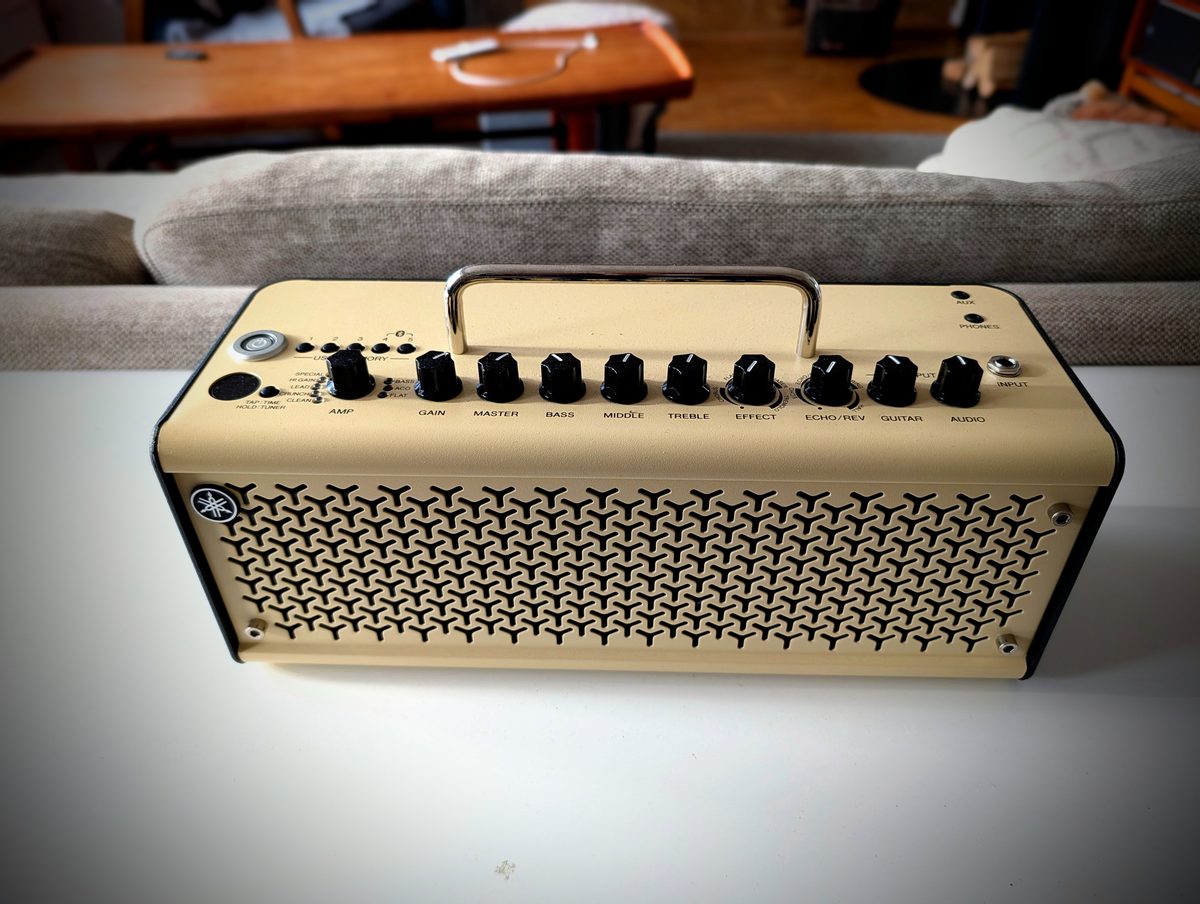
Yamaha THR10II — The One Amp That Works for the Whole House
Published 12 May 2026 · Updated May 2026
Four months in and it has done exactly what the research promised: one amp, any instrument, any room. The sound is genuinely good at home volumes and the resale market confirms everyone eventually reaches the same conclusion.
The Yamaha Pacifica was already in the house. What came next was the amp to go with it — and the brief was specific: something that worked for both guitar and bass, fitted into a home without taking over a room, sounded good at the volumes you actually play at home, and was simple enough that learning to use it was not its own project. We were starting with Yousician — my children and I — and the priority was removing friction, not adding it.
The Yamaha THR10II is where the research ended up, consistently and across multiple sources. It is not a budget amp. It is also not a specialist’s amp. It is the amp that the home musician community has converged on as the standard answer to “one amp for everything at home,” and after four months of use I understand why.
What I was looking for
The starting point was the dual-instrument requirement. In a household where both guitar and bass are in play, the obvious budget choice — one practice amp per instrument — is less obvious when you add up the cost, the space, and the quality of the result. A cheap guitar amp running bass sounds wrong. A cheap bass amp running guitar sounds flat. The alternatives that handle both without compromise are fewer than you might expect.
The second requirement was size. A full-size guitar amp in a living room or study is a commitment the space does not always permit. The THR10II is a desktop unit — roughly the size of a small speaker, designed to sit on a desk or shelf. It does not announce itself the way a traditional amp does. This matters for daily use in a home environment.
The third requirement was tone quality at low volumes. This is the gap where most practice amps disappoint. A cheap amp at bedroom volumes often sounds thin, buzzy, or just wrong — the speaker and circuitry are not optimised for quiet playing. The THR10II uses modelling technology derived from Yamaha’s higher-end gear, and it is specifically designed to sound good at the volumes where home practice actually happens.
The fourth requirement was simplicity. We were starting with Yousician and needed to plug in and play without configuring equipment before every practice session. The THR10II has sensible defaults and clear controls. The app adds depth when you want it. When you do not, it is not required.
What the THR10II is
The THR10II is a stereo desktop amp with two 3-inch speakers, modelling-based tone shaping for both guitar and bass, built-in effects (reverb, delay, chorus, and more), Bluetooth for playing along to music, and USB for direct recording. It runs on mains power.
The guitar channel models five amp types — Clean, Crunch, Lead, Brown (high gain), and Acoustic. The bass channel has its own voicing appropriate for low-end instruments. Switching between them takes one button press. This is the design: one amp, any instrument, immediate use.
The modelling is not a gimmick. Yamaha has been making professional modelling amplifiers for decades, and the THR line inherits that engineering. The tone at home volumes is genuinely good — not “good for its size” or “surprisingly decent,” just good. This was the consistent finding across reviews, forum threads, and owner reports, and it is consistent with four months of use.
Why this over alternatives
The THR10II is not the only option in its category, but it is the one that researchers and owners recommend with the most consistency. The Boss Katana Mini and Blackstar Fly are smaller and cheaper but lack the bass channel and the stereo imaging. The Fender Mustang Micro is excellent for headphone practice but does not fill a room. The Orange Crush 20 is a good small amp but guitar-only.
The THR10II is the intersection of the specific requirements: guitar and bass, good tone, compact form, simple use. It is also the amp with the strongest resale reputation in its category — which is not a trivial consideration. An amp that holds its value is one that owners would buy again and recommend to others.
Four months of ownership
January 2026. 3,590 SEK (€327). Used several times per week for guitar and bass practice, by adults and children, at home volumes.
The amp is exactly as described in the research. It sounds good immediately, requires no management between sessions, and has introduced no friction into the practice routine. The controls are clear. The Bluetooth works. The defaults are usable.
The one caveat in four months of use: deep tone customisation requires the app. The front panel controls are sufficient for everyday playing, but if you want to adjust specific effect parameters, you need the THR Remote app connected via USB or Bluetooth. This is not a problem in practice — we have not needed it — but it is worth knowing.
True cost of ownership
3,590 SEK (€327) at purchase. At ten years of expected use — well within reach for a well-built desktop amp with no moving parts to wear — the annual cost is 359 SEK (€33).
The realistic alternative for a guitar-and-bass household: two budget practice amps at 800–1,000 SEK (€73–91) each, replaced once over ten years. That is 3,200–4,000 SEK (€291–364) total for two amps that do not model correctly, do not have Bluetooth or USB, and do not have the same tone quality. The THR10II costs the same or less in total, with better results throughout.
The resale value adds another dimension. The THR10II moves quickly on second-hand markets and retains roughly 60–70% of purchase price in good condition. The actual net ownership cost, accounting for eventual resale, is considerably lower than 3,590 SEK.
Verdict
The research pointed here consistently. Four months in, the research was right.
One amp that works for guitar and bass, fits on a desk, sounds genuinely good at home volumes, and removes all friction from daily practice. At 359 SEK (€33) per year over ten years — and likely less after resale — this is the right single purchase for a multi-instrument household.
The simplicity was the brief. The THR10II is the answer.
True Cost of Ownership
| Metric | Value |
|---|---|
| Price paid | 3,590 SEK |
| Estimated lifespan | 10 years |
| Cost per year | 359 SEK |
| Budget alternative over same period | 5,000 SEK |
| Net saving vs. budget alternative | 1,410 SEK |
Ownership record
Purchased January 2026 · Reviewed after 4 months of ownership
Good fit for
- ✓Households where both guitar and bass are in play
- ✓Parents and children learning together — simple to use, sounds good immediately
- ✓Apartments and homes where a full-size amp is not practical
- ✓Anyone who wants Bluetooth, USB recording, and real amp tone in one compact unit
Not ideal for
- ✕Main stage live performance — it can work in a pinch but it is not built for that
- ✕High-volume playing where headroom matters more than tone at low levels
- ✕Those who only play one instrument and want the cheapest option
Pros
- +Works with guitar and bass — no compromise on either
- +Genuinely good tone at low volumes, which is where home practice actually happens
- +Built-in effects, Bluetooth audio, USB recording — complete without accessories
- +Compact enough for a desk, shelf, or small room without dominating the space
- +Strong resale market — holds value well and moves quickly when listed
Cons
- −Limited headroom for loud playing — not a stage amp at stage volumes
- −Deeper tone editing requires the THR Remote app
- −Higher upfront cost than single-instrument budget practice amps
Frequently Asked Questions
Can the Yamaha THR10II be used for bass as well as guitar?
Yes — this was the primary reason it came out ahead in research. The THR10II has a dedicated bass channel with appropriate voicing, not just a guitar amp running bass through it. At home practice volumes it handles both instruments properly. A single cheap practice amp for guitar is easy to find; one that does both without compromising either is not, and the THR10II is the standard recommendation in that category.
Is the Yamaha THR10II good for beginners?
Yes, and this was central to the purchase decision. We started learning with Yousician and needed an amp that worked immediately without dialling in or adjusting settings before every practice session. The THR10II has sensible defaults — you can plug in and start playing without understanding every parameter. The app adds depth for when you want it, but it is not required to get good sound. For a family starting out, that simplicity is worth a great deal.
Can the THR10II be used for a small gig or live performance?
In a limited sense, yes — the THR10II can be connected to a PA via its line output, and in a small, quiet venue it can serve as a stage monitor or direct feed. It is not a gigging amp in the conventional sense: no 12-inch speaker, no significant stage volume. But the option exists, and for the occasional small performance it removes the need for dedicated stage gear. Accessibility was part of the research brief, and this is part of what that means.
How does the Yamaha THR10II compare to cheaper practice amps?
The comparison changes when the requirement is guitar and bass in the same household. A budget guitar-only practice amp at 600–900 SEK (€55–82) is cheaper, but you need two — one for guitar, one for bass — or you compromise one instrument's sound. Two budget amps at 800 SEK each is 1,600 SEK (€145), and neither will have the tone quality, built-in effects, Bluetooth, or USB recording of the THR10II. Over ten years with one or two replacements, the costs converge. The THR10II is the better single purchase for a multi-instrument household.
What is the resale value of the Yamaha THR10II?
Good and consistent. The THR10II is a sought-after amp on the second-hand market — it tends to sell quickly and retains roughly 60–70% of its original value in good condition. This is worth factoring into the total cost of ownership: the net cost after eventual resale is meaningfully lower than the purchase price. This is also a signal of the product's quality; amps that disappoint do not hold their value.