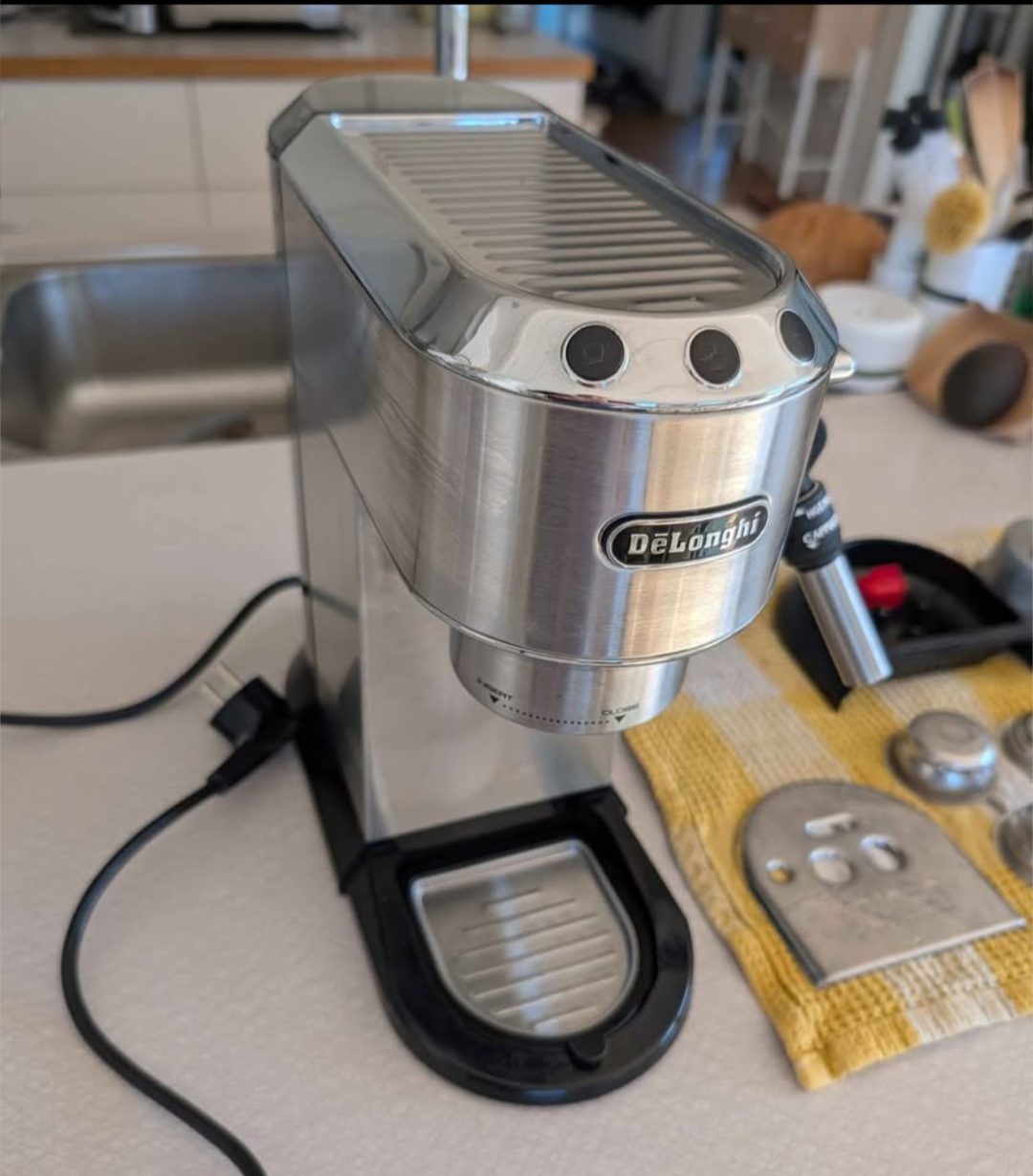
De'Longhi Dedica EC685 — The Entry Machine That Earned Its Upgrade
Published 10 May 2026 · Updated May 2026
The right entry machine for espresso at home — genuinely good for the price, capable of decent espresso and cappuccino with some care, and solid enough to hold its value on resale. Not the last machine I bought, but the right first one.
Link updates to your region automatically
This article is about a machine I no longer own — sold in September 2025 after four years of daily use, replaced by the Sage Dual Boiler BES920. It is worth documenting as a purchase because the arc of ownership — entry machine, learning period, deliberate upgrade, resale — is itself the story the site exists to tell.
The De’Longhi Dedica EC685 was the right first machine. It was not the destination.
What I was looking for
May 2021. I wanted to make espresso and cappuccino at home — three to four coffees per day, every day. The brief was capability at an accessible price, with a footprint that didn’t take over a kitchen counter. The Dedica is 15cm wide, which is the defining physical feature: it fits anywhere.
The alternative at this price range is a superautomatic machine, which produces easier but worse espresso through automation. I wanted to learn to make it properly. The Dedica is a traditional pump machine — you grind, tamp, and pull the shot yourself — which means there is something to learn, and something to improve.
1,569 SEK (€143). I bought it and started making espresso.
What the Dedica is
The EC685 is a thermoblock espresso machine. The thermoblock — a heated block through which water passes — provides fast heat-up (around 30 seconds) and a compact design. The limitation versus a real boiler machine: brew temperature is less stable and varies slightly between shots, and it is not adjustable. For a beginner learning the craft, this is not a critical constraint. For an experienced espresso drinker who wants to dial in temperature to the half-degree, it is the ceiling.
The machine has a single boiler/thermoblock system, meaning you pull the shot first and then texture the milk — there is no simultaneous brew and steam. This adds two to three minutes to the cappuccino workflow. In four years of daily use I adapted to this and it was fine.
The steam wand is real and functional — not the pressurised steam adaptor that some entry machines use to produce foam from lower steam pressure. Milk texturing on the Dedica requires some technique, but it produces proper microfoam when done correctly.
The build quality is honest for the price: metal body, solid construction, nothing that felt cheap in use. After four years of three to four coffees per day — somewhere between 5,000 and 6,000 brewing cycles — it still worked exactly as it did on day one when I sold it.
Four years of daily use
I used the Graef CM900 grinder with the Dedica for the full four years. I did not dial in obsessively — I learned the basics, found settings that worked, and used them. What I gradually understood was how limited the control actually was.
The Dedica produces a decent shot, but the coffee is flatter than what a more capable machine delivers. The crema is thinner, the texture less rich, and when I tried better beans and read more about what espresso should taste like, I noticed that the Dedica could not fully extract the character from the bean the way a better machine can. Good coffee beans made a difference, but there was a ceiling — notes that should have been present were muted or absent.
This is not a failure of the machine — it is what the machine is. At this price point and with a thermoblock, you get decent espresso that is difficult to consistently brew at high quality. The result varies between shots in ways that are hard to pin down and correct, because you don’t have the variables to work with. I am not a barista-level person, but I still noticed the gap once I had something to compare it against.
What changed over four years was understanding what I could not control: brew temperature. The thermoblock does not hold a stable brew temperature the way a boiler with PID does, and once I understood what temperature stability provides, I could feel the absence of it.
That is the right learning arc for an entry machine. You learn the craft on a capable but limited tool, and when the tool is the constraint rather than the operator, you know what to upgrade to.
The upgrade and the resale
September 2025: I bought the Sage Dual Boiler BES920 for 11,590 SEK (€1,054) and sold the Dedica the same month for 500 SEK (€45).
The residual value after four years of heavy daily use is worth noting. 500 SEK is 32% of the 1,569 SEK (€143) purchase price — genuine resale recovery on a machine that had served as a daily workhorse. The Dedica maintains its value on the second-hand market because it is a genuinely good entry machine that new buyers can use immediately.
Net cost of ownership: 1,069 SEK (€97) over 52 months — approximately 247 SEK (€22) per year. For a machine used daily for four years, that is a low cost of entry into home espresso.
What the Dedica taught
The fundamentals: tamping, extraction length, grind basics, how bean choice affects the cup. Four years with the Dedica built enough of a foundation that when the Sage arrived, I dialled in to a good shot within the first few pulls.
But the more important lesson was understanding the limitations. The Dedica is a somewhat standardised machine — it does not give you much to work with when something is off. The variables you can actually change are few, and the consistency between shots is hard to control precisely. I noticed this particularly when trying better beans: the coffee improved, but there was clearly more in the bean than the machine could extract. The Dedica showed me what I was working towards, in part by showing me where the ceiling was.
The Sage’s dual boilers and PID control opened up the variable I couldn’t touch on the Dedica — brew temperature — and that, combined with a proper grinder, is where the gap in coffee quality actually came from.
Verdict
A well-built entry machine that lasted four years of heavy daily use, sold still working for 500 SEK. Net cost: 1,069 SEK (€97) over four years. Right espresso, right cappuccino, right learning environment.
Not the last machine — the right first one.
The upgrade to the Sage Dual Boiler was not the Dedica failing. It was me knowing what I wanted next, and having learned it on a machine that did exactly what it was supposed to do.
True Cost of Ownership
| Metric | Value |
|---|---|
| Price paid | 1,569 SEK |
| Estimated lifespan | 5 years |
| Cost per year | 247 SEK |
| Budget alternative over same period | 0 SEK |
| Resale value (when sold) | 500 SEK |
Ownership record
Purchased May 2021 · Reviewed after 52 months of ownership
Good fit for
- ✓Espresso and cappuccino at home without a large upfront commitment
- ✓Anyone new to home espresso who wants to learn the basics before investing further
- ✓Small kitchens — the Dedica is notably narrow at 15cm wide
- ✓Those who want a machine with reasonable resale value when they upgrade
Not ideal for
- ✕Those who want dual-boiler precision or temperature stability for dialling in
- ✕High-volume use — 3-4 coffees per day is at the upper end of its comfortable range
- ✕Anyone who wants to understand extraction variables in depth (the thermoblock limits this)
Pros
- +Compact footprint — 15cm wide, fits any kitchen
- +Capable of genuinely good espresso and proper cappuccino at this price
- +Solid build quality — lasted four years of 3–4 coffees per day without mechanical failure
- +Good resale value — sold for 500 SEK after four years
- +Honest entry point into home espresso without overcommitting
Cons
- −Thermoblock design, not a real boiler — brew temperature is less stable and not adjustable
- −Cannot brew and steam simultaneously — one then the other
- −Limited temperature control compared to machines with PID
- −Not a long-term destination machine for serious espresso
Frequently Asked Questions
Is the De'Longhi Dedica EC685 good for espresso?
Yes — at around 1,500–2,000 SEK (€136–182) it is one of the better entry-level options. The thermoblock heats water on demand and, with some technique, delivers espresso and cappuccino that is genuinely good rather than merely drinkable. The limitation is that brew temperature is not adjustable and varies slightly between shots, which matters more as you develop taste and want to dial in precisely. For a first home espresso machine at this price, it is a solid, sensible choice.
What is the difference between a thermoblock and a real boiler?
A thermoblock heats water on demand as it passes through a heated element — fast to heat up, compact, and affordable to produce. A boiler holds water at temperature in a pressurised vessel, providing more stable and consistent brew temperature. A dual-boiler machine has separate boilers for brewing and steaming, each PID-controlled independently. The Dedica's thermoblock is adequate for entry-level use; for serious espresso where brew temperature is a controlled variable, a boiler with PID is the next step.
How long did the De'Longhi Dedica last with heavy use?
Four years and approximately 5,000–6,000 brewing cycles at 3–4 coffees per day. The machine was still fully functional when sold — the upgrade was not because it failed but because I outgrew its capabilities. The Dedica was sold to a new owner in September 2025 in working condition, which is a testament to its build quality at the price.
What did the De'Longhi Dedica teach you about espresso?
Tamping, extraction length, grind, and bean choice — the basics. But also the limits of what a thermoblock machine can do. The Dedica produces a decent shot, but the coffee is flatter than what a capable machine delivers. Crema is thinner, the texture less rich, and with better beans you can hear what the machine is missing rather than what it is providing. I am not a trained barista, but I still noticed the gap once I had something to compare against. The right way to use an entry machine is to learn on it, recognise when it is the constraint rather than your technique, and then upgrade with confidence.
What did the Dedica sell for after four years?
500 SEK on the second-hand market in September 2025 — roughly 32% of the original purchase price after four years of daily use. Net cost of ownership: 1,069 SEK (€97) over 52 months, approximately 247 SEK (€22) per year. It maintains its value because it is a genuinely good entry machine that new buyers can use immediately.
Ownership Log
Sold for 500 SEK after four years
Sold the Dedica EC685 in September 2025 after upgrading to the Sage Dual Boiler. It still worked perfectly — no faults, no repairs, nothing replaced. Sold via Blocket for 500 SEK, which puts the net cost of four years of daily use at 1,069 SEK. The buyer was also upgrading from a capsule machine, which felt like the right handover.