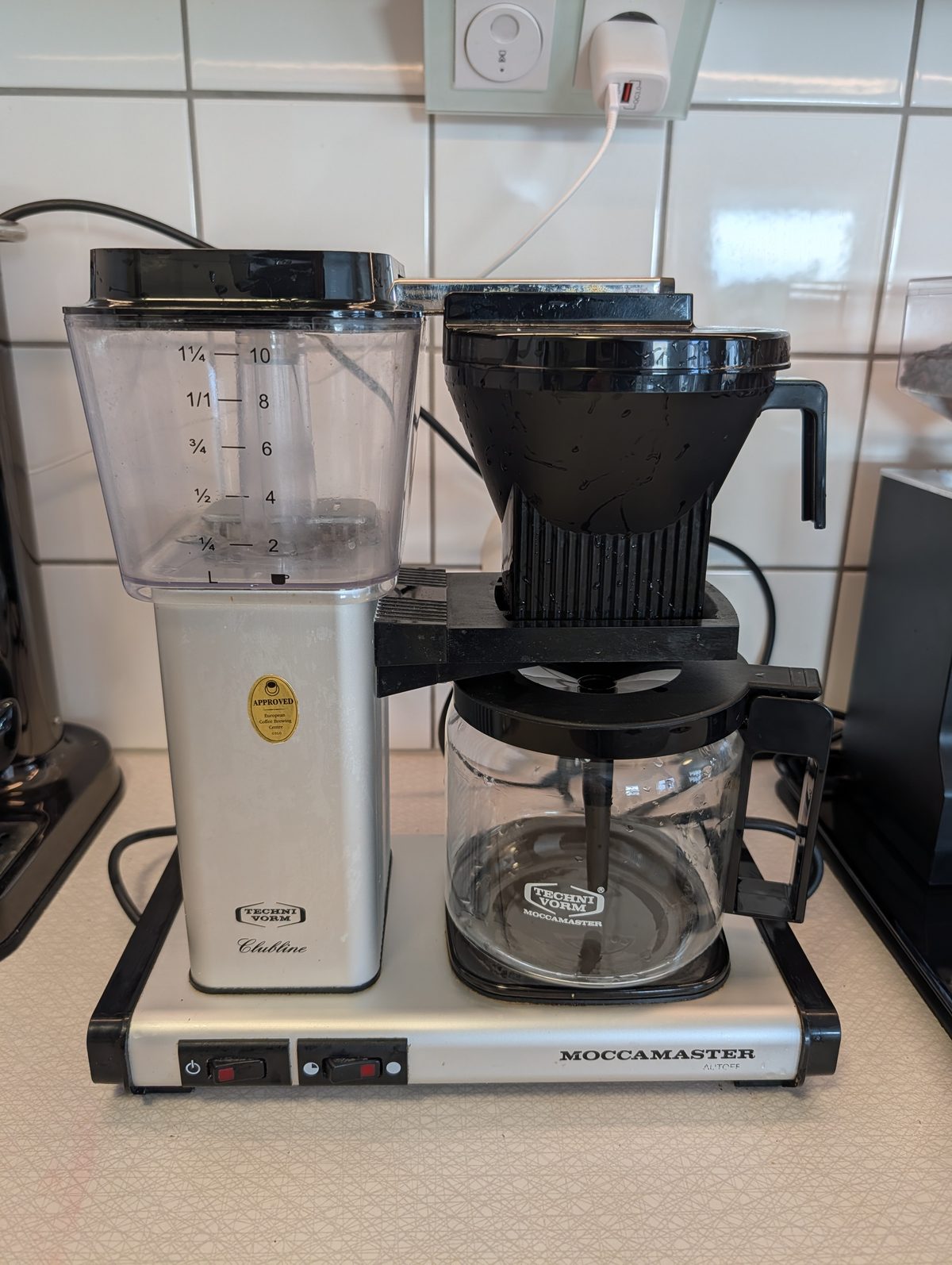
Technivorm Moccamaster — Thirteen Years and Still the First Thing On in the Morning
Published 10 May 2026 · Updated May 2026
Thirteen or fourteen years of daily use, still performing exactly as on day one. At approximately 64 SEK per year of ownership, this is what value looks like when you measure it correctly.
Link updates to your region automatically
Our Moccamaster has been in daily use for at least thirteen or fourteen years. I say “at least” because I cannot pinpoint exactly when we bought it — it is one of those purchases that predates the habit of documenting purchases carefully, acquired before I thought of appliances as objects with ownership histories worth tracking.
What I know: it was there in the morning, making good coffee, before any of the espresso equipment arrived. It is still there now.
What we were looking for
The brief at the time was what it always is for a filter brewer: something that makes consistently good coffee every morning without requiring involvement. We had been through the pattern of cheap filter brewers — bought at reasonable prices, adequate for a year or two, and then gradually producing worse coffee before eventually developing a fault. The heating element in a cheap brewer degrades in a way that is almost invisible from the outside: the machine continues to run, the coffee continues to come out, but the brew temperature drops over time and the quality drops with it.
The Moccamaster was a deliberate break from that pattern. The price was higher than what we had bought before — somewhere in the 1,500–1,800 SEK (€136–164) range at the time, which in 2012 was a meaningful commitment for a filter brewer. The credentials were clear: handmade in the Netherlands, SCA-certified for brew temperature, with a track record of multi-decade longevity in homes across Northern Europe.
We bought it and did not think about it again, which is the outcome.
What the Moccamaster is
Technivorm has been making the Moccamaster in Amerongen, in the Netherlands, since 1969. Not a tribute version, not a heritage reissue — the same machine, with the same engineering approach, with minor aesthetic updates over the decades. A company making the same product for more than fifty years is a quality signal in itself: the design survived because it worked.
The machine heats water with a copper heating element and delivers it to the coffee bed at 92–96°C — the Specialty Coffee Association’s certified range for filter brewing. Most filter brewers at any price run at 80–85°C. At that temperature the extraction is partial: the coffee is sour and flat, missing the compounds that only release at higher temperatures. The difference is not subtle. The Moccamaster extracts correctly, and the coffee it produces reflects that.
The brew cycle completes in under six minutes for a full 1.25L carafe. Speed matters: coffee holding on a warming plate for thirty minutes is not the same drink it was at six. The Moccamaster brews fast because the heating element has enough power to maintain temperature throughout the cycle, not just at the start.
Every component is replaceable and stocked by Technivorm. The heating element, thermostat, brew arm, spray head, carafe, lid, rubber gaskets — all of them. Technivorm’s policy is that parts will be available for the life of any machine they have ever sold. There are Moccamasters from the 1970s still in use.
Thirteen years of ownership
Thirteen years of daily use, every morning, producing several cups each time. That is somewhere north of 25,000 brewing cycles. The heating element, thermostat, and brew performance are unchanged from new. The machine is running exactly as it ran in the first week.
This is the Moccamaster ownership report: no dramatic durability story, no near-failure or crisis repair. Just a machine that works every day without asking for attention.
How it performs
The coffee from the Moccamaster has been the reference point for filter coffee in this household for over a decade. When we travel and encounter other filter coffee — hotel machines, cheap office brewers, most café filter options — the difference is immediate. The Moccamaster extracts fully. Most other machines do not.
The six-minute brew time preserves aromatics. The correct temperature extracts the complete range of soluble compounds from the ground coffee. These are not audiophile-level distinctions or marginal improvements only detectable in controlled testing — they are the difference between coffee that tastes flat and dull and coffee that tastes like the bean it came from.
The machine rewards good coffee inputs. Fresh beans, ground correctly before brewing, produce noticeably better results than pre-ground stored coffee. But the machine itself is not the variable — it is a stable, correct platform that does not compromise what you put into it.
True cost of ownership
I estimate the purchase price at approximately 1,600 SEK (€145) — typical for the KB 741 in Sweden around 2012. The only additional cost over thirteen years has been paper filters and the occasional descaling treatment. There has been no mechanical maintenance required.
At 25 years of expected lifespan — conservative, given that the machine is at 13 years and shows no indication of stopping — the annual cost is 64 SEK (€5.50). Eight cheap filter brewers at around 600 SEK (€55) over the same period would cost roughly 4,800 SEK (€436) and produce consistently inferior coffee throughout. The Moccamaster costs 1,600 SEK (€145) total.
Verdict
The first thing on in the morning for at least thirteen years. Still running exactly as on day one. Coffee exactly as good as the first week.
At 64 SEK per year and no meaningful maintenance over the ownership period, this is the clearest buy-once case in the kitchen. The machine that demonstrates the philosophy more plainly than anything else on this site: buy the right thing once, and stop thinking about it.
True Cost of Ownership
| Metric | Value |
|---|---|
| Price paid | 1,600 SEK |
| Estimated lifespan | 25 years |
| Cost per year | 64 SEK |
| Budget alternative over same period | 4,800 SEK |
| Net saving vs. budget alternative | 3,200 SEK |
Ownership record
Purchased January 2012 · Reviewed after 172 months of ownership
Good fit for
- ✓Anyone who brews filter coffee every morning and wants it consistently good
- ✓Households where the brewer runs daily for years — or decades
- ✓Those who want SCA-certified brew temperature without manual pour-over technique
- ✓The clearest possible demonstration of the buy-once philosophy in a kitchen appliance
Not ideal for
- ✕Espresso — this is a filter brewer only
- ✕Single-cup brewing — a batch brewer at this price is not optimised for one cup
- ✕Those who want app control, programmable timers, or digital displays
Pros
- +Brews at 92–96°C — the SCA-certified temperature range for full filter extraction
- +Six-minute full carafe brew time preserves aromatics that longer cycles destroy
- +Handmade in Amerongen, Netherlands — genuine Dutch manufacturing since 1969
- +Every single component is replaceable: heating element, thermostat, brew arm, carafe, lid
- +Still running perfectly after 13+ years of daily use
Cons
- −No programmable timer — it is an on/off switch
- −Glass carafe breaks if dropped (thermal carafe version available at higher price)
- −No programmable timer on the base model — the Clubline adds a timer, but at a higher price
Frequently Asked Questions
How long does a Technivorm Moccamaster actually last?
Nobody knows the ceiling, because the oldest units in active use are over 40 years old. Our household Moccamaster has been running daily for at least 13–14 years and the heating element, thermostat, and brewing performance are unchanged from day one. Technivorm keeps spare parts available for every model they have ever produced, so the machine can be maintained indefinitely.
Why is the Moccamaster so much more expensive than other filter brewers?
The price difference is construction and lifespan. A typical filter brewer at 600–900 SEK uses cheap heating elements that run at 80–85°C rather than the SCA-correct 92–96°C, producing under-extracted, flat coffee. It also typically fails within 3–5 years. The Moccamaster uses a copper heating element, brews at correct temperature in under six minutes, and is designed to be repaired rather than replaced. At 64 SEK per year over 25 years, it costs approximately the same as a cheap brewer replaced every three years — with consistently better coffee throughout.
What is the SCA certification and why does it matter for coffee quality?
The Specialty Coffee Association (SCA) Home Brewer Certification requires that a brewer reach 92–96°C within the first minute of brewing and complete a full batch in under ten minutes. Most consumer brewers fail on temperature — the heating elements are inadequate and the water reaches coffee at 80–85°C, which under-extracts and produces sour, flat results. The Moccamaster consistently hits the SCA window and completes a full 1.25L in around six minutes. This is not a marketing claim — it is a third-party certified measurement.
Can the Moccamaster be repaired?
Yes — this is central to the ownership case. Technivorm manufactures spare parts for every component of every Moccamaster model ever produced. The heating element, thermostat, brew arm, spray head, carafe, lid, and gaskets are all available. Common repairs cost 200–400 SEK and are user-performable or can be done by any appliance repair shop. Technivorm's repair-first policy is explicit: the machine is designed to be maintained, not discarded.
Ownership Log
13+ years and never been serviced
The Moccamaster has never been repaired. Never had a part replaced. The heating element still hits brewing temperature consistently, the carafe seal is intact, and the on/off switch works as it always has. The only maintenance has been descaling every few months with citric acid. For a machine bought around 2012 and used daily, that track record is the whole argument for the brand.