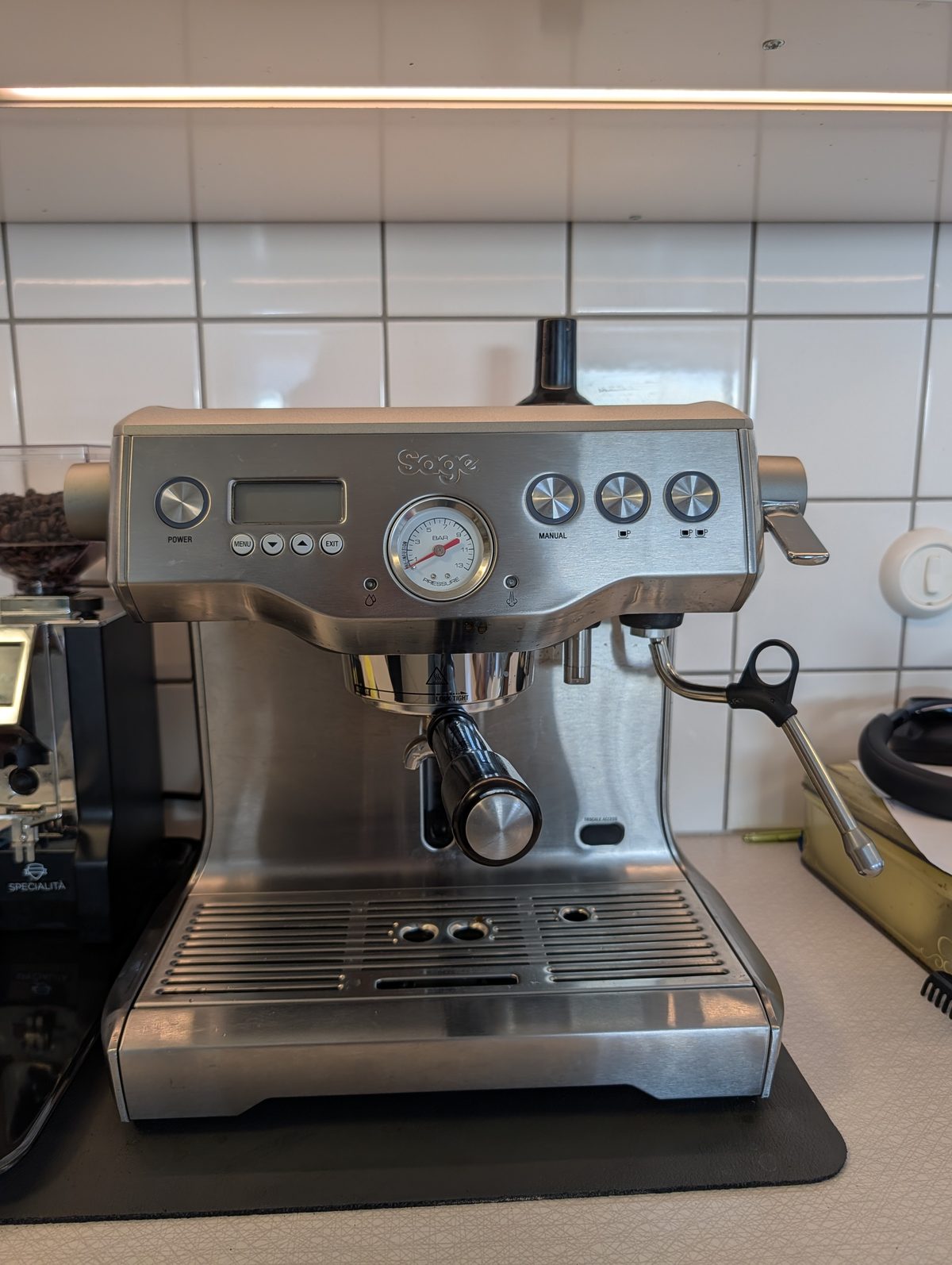
Sage Dual Boiler BES920 — The Espresso Machine I Stopped Thinking About
Published 10 May 2026 · Updated May 2026
The machine that made espresso a solved problem at home. Full dual boilers with PID at 11,590 SEK (€1,054) — no other machine delivers this at this price. The coffee quality is a different category from entry-level, consistently, every day.
Link updates to your region automatically
I drank espresso and cappuccino on a De’Longhi Dedica EC685 for four years — three to four coffees a day, consistently. It was a good entry-level machine for what it was: a thermoblock design at an accessible price, capable of decent espresso once dialled in, and well-built enough to survive four years of that volume. When I sold it in September 2025, it still worked. The upgrade was not about failure — it was about knowing what I was missing.
The Sage Dual Boiler BES920 is what I found when I went looking.
What I was looking for
After four years on the Dedica I understood the limitation clearly: a thermoblock machine heats water on demand rather than holding a stable temperature in a dedicated boiler. For everyday cappuccinos this is adequate. For espresso where you want to understand what brew temperature is actually doing to extraction — and then change it deliberately — it is not the right tool. I also knew that whatever I upgraded to, the Graef CM900 grinder I had been running with the Dedica would not be good enough for it. That would need to change too.
The upgrade search had specific criteria: dual boilers (dedicated brew and steam, simultaneously ready), PID temperature control on both, and adjustable pre-infusion. These are the controls that turn a machine into a platform you can actually learn on.
At this specification, the Sage Dual Boiler stands apart — no other machine delivers true dual boiler performance at this price point. Higher-end Italian machines exist and are beautiful objects, but the cost gap is significant and the coffee improvement over the Sage is not proportional to the price difference. I found the BES920 at 11,590 SEK (€1,054) through research — a meaningful discount from the standard 14,000–15,000 SEK (€1,273–1,364) retail — and the decision was clear.
What the Sage Dual Boiler actually is
Two boilers means two boilers: one for brewing, one for steam, each running at its own temperature, independently controlled. The steam boiler is always hot. The brew boiler holds whatever temperature you set — 93°C, 94°C, 95°C, adjustable in half-degree increments via PID. You pull a shot and texture milk at the same time if you want. There is no waiting, no routine, no thermal management.
PID temperature control holds the brew boiler within 0.5°C of target. In practice this means brew temperature is removed from the variables I am troubleshooting when a shot is off. I can change one thing at a time — grind size, dose, yield — and know that temperature is stable. This is the machine becoming a scientific instrument rather than an additional variable.
Pre-infusion runs water through the puck at low pressure before the pump reaches full pressure. For light roast espresso — the range I work with most — a longer pre-infusion lets the grounds saturate evenly before extraction begins, reducing channelling and producing a more even yield. The Sage makes this adjustable; cheaper machines either do not pre-infuse or do it at a fixed, non-optimal duration.
The pressure gauge tells you what is happening in the group head during extraction. A correct grind at correct dose produces a curve that rises to 9 bar and holds there through the shot. Under-extracted (too coarse) and the pressure never climbs. Over-extracted (too fine) and it spikes and stalls. The gauge turns the shot from an invisible process into something you can read and learn from.
On the build: the BES920 is a well-made appliance in stainless steel, but it is not the object a full Italian machine is. It does not have the same material weight or the machined aesthetic of a Lelit Bianca. This is honest — it was built to a price point that made it accessible, and the trade-off is finish, not function. The coffee it produces is the same quality. Whether the premium for a more beautiful machine is worth it is a question about what you value beyond the cup.
Ownership record
Bought September 2025. 11,590 SEK (€1,054).
Eight months of daily use at time of writing, at three to four coffees per day. Machine is performing without issue.
Build quality and setup
Setup was straightforward. The water reservoir is accessible at the top. The PID controls are in the front panel menu. Connecting the steam wand and portafilter is immediate. The first session required calibration — setting the brew temperature, adjusting the pre-infusion duration, dialling in grind to the first shot — but none of this is complex if you have any espresso background.
The internal layout is accessible for maintenance. The group head screws off for cleaning and shower screen replacement. The backflush routine with the blind filter takes five minutes. Gasket replacement, when the time comes, is a user-level job with common tools and a part that costs less than 100 SEK (€9).
How it performs
The coffee is a different category from what I was making on the Dedica. Not a marginal improvement — a consistent, repeatable quality that the Dedica could approach on a good day but could not sustain. This is the thing that is hard to communicate before you have experienced it: the gap is not about occasional good shots, it is about every shot landing at the same level.
The dual boiler configuration matters daily. The steam boiler is always at pressure — I pull a shot while the steam wand heats the milk, and by the time the shot is done, the milk is textured. The workflow is continuous in a way that the Dedica could not match.
After the Sage I also upgraded to the Eureka Mignon Specialità grinder — the Graef CM900 I had been running was not capable of using what the Sage could deliver. Once the grinder matched the machine, the results were at a level I had not had at home before.
Cleaning and maintenance is also straightforward. The machine runs backflush cleaning programs directly from the front panel — weekly for daily use. The group head, shower screen, and steam wand are all easy to access and clean. It does not feel like maintenance; it is a five-minute routine that keeps the machine performing.
True cost of ownership
11,590 SEK (€1,054) at purchase — found at this price through research, below standard retail of 13,000–15,000 SEK (€1,182–1,364).
Over a ten-year ownership horizon with normal maintenance (gasket replacements, periodic descaling, shower screen replacement) I estimate total costs at approximately 13,000–14,000 SEK (€1,182–1,273) — around 1,300–1,400 SEK (€118–127) per year.
It is honest to say that running a sequence of cheaper machines over ten years could cost less — depending on how long they last and what you replace them with. But each replacement is a discarded machine, and the quality at no point approaches what the Sage delivers from day one. The sustainability argument and the quality argument both point the same direction: one well-made machine that lasts, rather than a cycle of budget replacements that never reach the same level.
Verdict
Four years on the Dedica, then the Sage Dual Boiler. The upgrade was not marginal — it was a category step. Full dual boilers, PID temperature control, real pre-infusion: the machine that makes espresso a solved problem at home.
Found at 11,590 SEK (€1,054). Not as beautiful as a full Italian stainless machine, but the coffee from it is the same standard, and the 10,000 SEK (€909) difference buys other things. At around 1,159 SEK (€105) per year over ten years, it earns its counter space.
True Cost of Ownership
| Metric | Value |
|---|---|
| Price paid | 11,590 SEK |
| Estimated lifespan | 10 years |
| Cost per year | 1,159 SEK |
| Budget alternative over same period | 0 SEK |
Ownership record
Purchased September 2025 · Reviewed after 8 months of ownership
Good fit for
- ✓Anyone who drinks 3-4 espressos or cappuccinos per day and wants café quality at home
- ✓Those who have outgrown an entry-level machine and want a real upgrade, not a marginal one
- ✓Pairing with a quality burr grinder — the machine will expose and reward a good grinder
- ✓Those who want dual boiler without spending 4,000–5,000 SEK more for the Italian alternatives
Not ideal for
- ✕Beginners who want push-button espresso — this machine rewards learning to dial in
- ✕Very small kitchens — the footprint is real
- ✕Those who want the premium build feel of a full stainless Italian machine
Pros
- +True dual boilers: steam always ready, no wait between shot and milk
- +PID temperature control on both boilers — brew temperature is a fixed variable, not a guess
- +Adjustable pre-infusion: meaningfully affects extraction quality on lighter roasts
- +User-serviceable internals — gaskets, solenoids, shower screens all accessible and available
- +Found at 11,590 SEK — a significant discount below typical retail of 13,000–15,000 SEK
Cons
- −Build finish is good but not at the level of the full Italian stainless machines it competes with on performance
- −Requires dialling in — no plug-and-play result without a matched grinder and recipe
- −Substantial footprint — 36cm wide and deep, needs dedicated counter space
- −Water quality matters: needs soft water or filtering to keep descaling intervals reasonable
Frequently Asked Questions
How does the Sage Dual Boiler compare to the Breville Dual Boiler?
They are the same machine — Sage is the Breville brand name in Europe and Australia. The BES920 is the European model designation. Specifications, internals, and parts compatibility are identical. Any community discussion of the Breville Dual Boiler applies directly to the Sage version.
What maintenance does the Sage Dual Boiler need?
Less than you might expect. The machine runs cleaning programs directly from the front panel — backflushing with the blind filter takes five minutes and the machine walks you through it. Group head gasket replacement every 12–18 months, and descaling on a schedule based on water hardness (soft water extends this significantly). The group head, shower screen, and steam wand are all easy to access. Sage also prompts cleaning cycles on the display, so you do not need to track it manually. All maintenance is user-performable without specialist tools.
What grinder do you pair with the Sage Dual Boiler?
The Eureka Mignon Specialità, bought in January 2026 — a few months after the Sage, specifically because the Graef CM900 I had been using with the Dedica could not keep up with what the Sage was capable of. The machine exposes a weak grinder immediately. A quality espresso grinder — stepless adjustment, flat or quality conical burrs — should be considered part of the system. The machine's precision is wasted without grind consistency to match it.
How long does the Sage BES920 last?
With proper maintenance the machine is built for 10+ years in home use. The pump and boilers can be replaced by a competent appliance technician if needed. Common user-replaced items — gaskets, O-rings, shower screen — are consumables with normal intervals. This is not a sealed appliance: it is designed to be serviced, which is the durability feature.
Ownership Log
8 months in — dialled in, no issues
Eight months of daily use — typically two to three shots in the morning, occasional afternoon pulls. No faults, no error codes, nothing unexpected. The PID is stable and the pre-infusion profile I settled on early has stayed consistent. The steam boiler is the part of the machine I underestimated initially: having steam always ready without waiting changes the workflow more than I expected. The drip tray fills faster than on the Dedica, which is the only mild nuisance. Still calibrating grind settings as I work through different roasts.